BACK TO ALL NEWS
KIX LAC and the Education Endowment Foundation advance the use of evidence to strengthen foundational learning in early childhood
December 11th, 2025.
11 de December de 2025
KIX
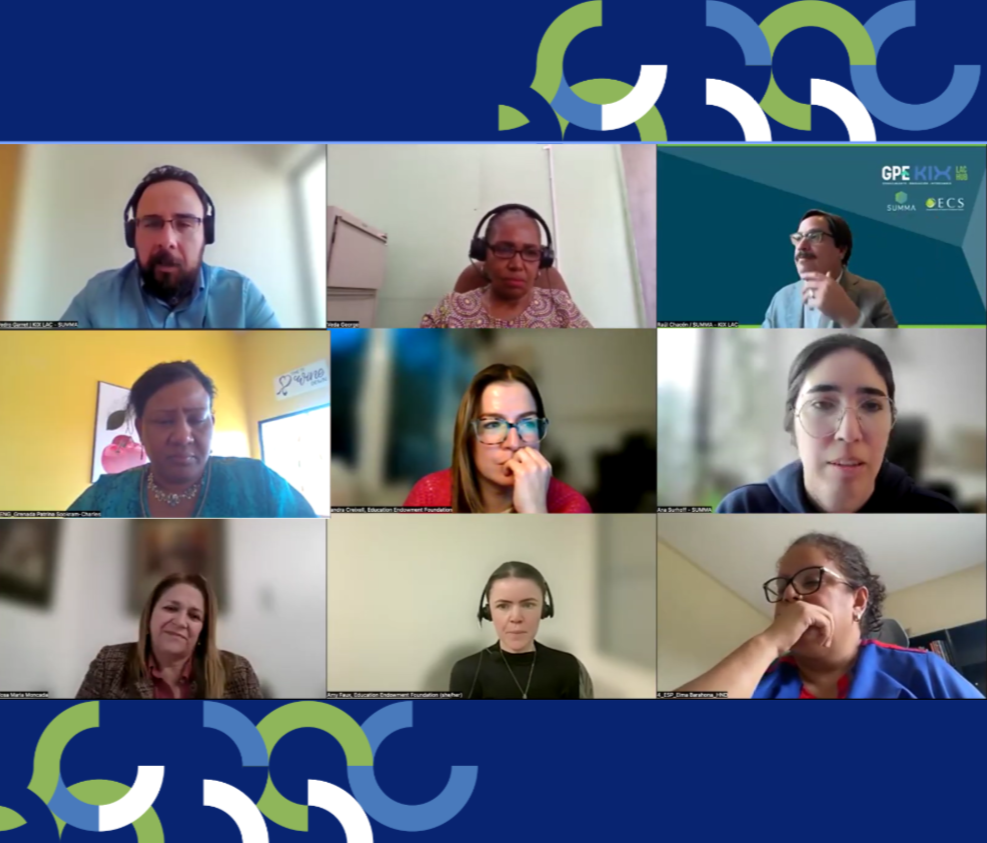
As part of the Knowledge Mobilization Cycle on the Use of Evidence for the Early Childhood Education and Care, the Knowledge and Innovation Exchange (KIX) for Latin America and the Caribbean (LAC)—an initiative of the Global Partnership for Education (GPE) and Canada’s International Development Research Centre (IDRC), regionally led by SUMMA and the Organization of Eastern Caribbean States (OECS)—held the workshop “From Evidence to Action: Pedagogical Innovations and Cost-Effective Practices for Early Childhood Education.” The session, centered on strengthening early childhood education through planning strategies, featured the Early Years Toolkit as its main resource and brought together ministry officials and key stakeholders from KIX LAC Hub member countries. The event took place on November 26, 2025.
This initiative builds on the collaboration that SUMMA and the Education Endowment Foundation (EEF) have maintained since 2017. United by a shared goal of reducing income-related learning gaps, this partnership has expanded access to international, cost-effective innovations. A key milestone in this joint effort is the integration of the Teaching and Learning Toolkit into the Effective Educational Practices Platform.
The workshop also aligns with the “Antigua Commitment,” signed during the 2025 KIX LAC Regional Meeting, which reaffirms the urgent priority of ensuring foundational learning—such as literacy and numeracy—from the earliest years and strengthening the use of evidence to advance educational justice.
The session was led by Education Endowment Foundation representatives Amy Faux, Senior International Manager, and Sandra Creixell, Early Years and Stronger Practice Hubs Project Manager, who jointly presented the Early Years Toolkit. They explained how this resource, designed to democratize access to educational research, synthesizes more than 450 impact studies to provide decision-makers with clear information based on three critical variables: implementation cost, security of the evidence, and potential impact on learning.
They then explored practical applications of these findings by highlighting two high-impact, low-cost approaches. First, in the area of Communication and Language, they emphasized strategies such as interactive reading and vocabulary modeling, which can generate up to seven additional months of learning progress. Second, they presented approaches to strengthen early numeracy development, a key foundation that helps children from disadvantaged contexts begin school with stronger mathematical readiness.
To illustrate how evidence can be translated into action, they discussed case studies such as the ShREC model in England—which simplifies high-quality interactions into four steps (Share attention, Respond, Expand, Converse)—and the “Evidence Tori Dey” initiative by eBASE Africa in Cameroon, which uses storytelling to share research findings in culturally relevant ways.
Following the presentations, participants joined regional working groups to analyze local challenges. In Central America, representatives identified the lack of specific methodologies and local data on which interventions are most effective. They reflected on early rejection of mathematics among students and stressed the importance of listening more closely to children and providing stronger support to teachers in the classroom. They also raised concerns about widening digital divides if technology is introduced without considering rural infrastructure gaps.
In the Caribbean, participants highlighted evidence as a powerful tool for policy influence and legislative development in sectors seeking formalization. They also discussed the role of teachers’ unions in professionalization processes and expressed deep concern about the continuity of learning for the most vulnerable children when returning to households without the resources needed to support their development.
The session concluded with a key reflection on equity: new practices must ensure that no child is left behind. Evidence has real meaning when it interacts with contextual knowledge and teacher expertise, strengthening local capacities and promoting environments where evidence use becomes part of everyday decision-making. From this perspective, schools emerge as true agents of change, ready to connect knowledge, scale innovations, and learn alongside other countries. In this regard, this workshop aimed to close the year by sharing useful tools that serve as inputs for designing more effective and sustainable education policies, with the ultimate goal of closing gaps and paving the way for educational justice for every girl and boy.
This focus on practical tools reflects the central mission of SUMMA and the KIX LAC Hub: generating regional public goods that strengthen education systems. In this line of work, SUMMA will continue advancing the contextualization of the Early Years Toolkit for Latin America and the Caribbean during 2026. To further support decision-making, foster regional collaboration, and advance equity and inclusion, we also make our open and free resources available: the Innovation Map, the Effective Practices Platform, Edudata, Open, and Impacta+, all accessible on our website.
➡️Read the workshop systematization report by clicking here



Strategic partners