RGEM Report
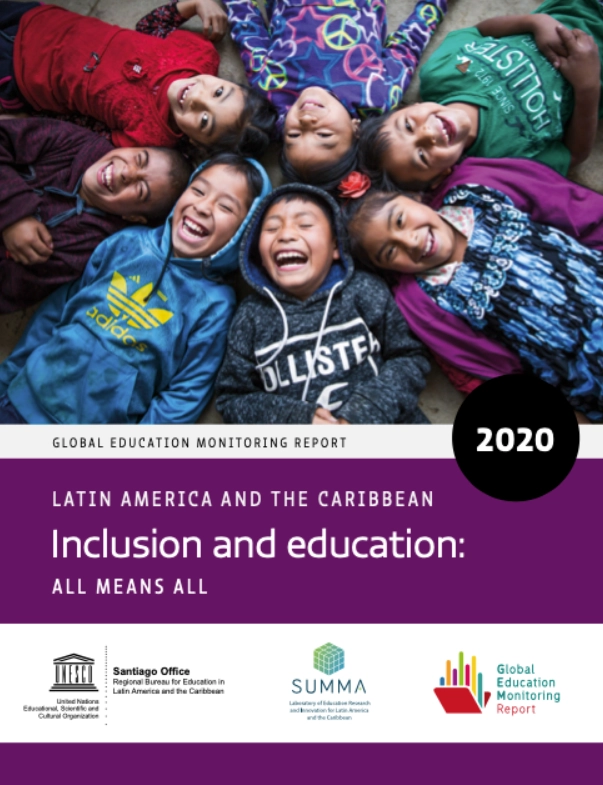
Global Education Monitoring Report (GEM). It is an independent, accredited and empirically based report published by UNESCO. The GEM LAC 2020 Report is the version for Latin America and the Caribbean, prepared by SUMMA in partnership with UNESCO.
UNESCO – SUMMA Partnership
Prepared by the GEM Report, the Regional Office for Education in Latin America and the Caribbean (OREALC/UNESCO Santiago) and SUMMA, the GEM Report 2020 Latin America and the Caribbean- Inclusion and education: All means all, offers a deep dive of the central challenges and the key solutions to achieve greater inclusion in education, in a region characterized by the largest and most challenging socioeconomic inequalities in the world.
Within the framework of this report, 29 studies were prepared on 8 dimensions of exclusion. The Report covers access to education for Venezuelan migrants in Colombia, as well as the exclusion faced by children living in rural and remote areas in countries such as Suriname and Brazil; those with disabilities in Nicaragua; access to education for girls in Peru and boys in Jamaica; sexual orientation in Mexico and Chile; and young people in a situation of deprivation of liberty in Uruguay. It also explores how the Covid-19 pandemic has exposed and deepened the disparities that already existed in education.
It is accompanied by a new global online platform, Profiles Enhancing Education Reviews (PEER) which contains a series of education profiles on countries’ laws and policies related to inclusion and education to facilitate peer learning and regional dialogue.
Project Background
1
School systems reflect the highly unequal societies of the countries in which they are located. Latin America and the Caribbean continues to be the most unequal region in the world. In 21 countries, boys and girls from the richest 20% of the population are, on average, five times more likely to complete upper secondary than boys and girls from the poorest 20%. In Chile and Mexico, to achieve a uniform socioeconomic mix, half of the student body would have to be reassigned to other schools.
2
Identity, origin and ability determine educational opportunities. In Panama, in 2016, 21% of indigenous men between the ages of 20 and 24 had completed secondary school, compared to 61% of their non-indigenous peers. In Paraguay and Honduras, 32% of indigenous men and women are illiterate. In 2015, Afro-descendants were 14% less likely to complete secondary education than their non-Afro-descendant peers in Peru and 24% less likely in Uruguay. On average, adolescents between the ages of 12 and 17 with disabilities were 10% less likely to attend school than those without any disability.
3
Mechanisms of discrimination, stereotypes and stigmatization affect all students at risk of exclusion in a similar way and affect their learning. Half of the 15-year-old students in Latin America did not reach the minimum level of proficiency in reading. In third grade, students who spoke the predominant language of their country at home were three times more likely to read and understand what they read than their peers. In seven countries, lesbian, gay, bisexual, and transgender people said they faced hostility at school; male and female students who suffered higher levels of victimization were at least twice as likely to skip school.
4
While some countries are moving towards inclusion, misperceptions and segregation still abound. About 60% of the countries in the region have a definition of inclusive education, but only 64% of those definitions cover multiple marginalized groups. That means most countries have yet to embrace a broader concept of inclusion. The ministries of education of the countries of Latin America and the Caribbean have been the most active in the formulation of laws related to individual groups, for example, in relation to disability (95%), gender (66%) and minorities ethnic and indigenous peoples (64%). But in the case of students with disabilities, in 42% of the countries the laws provide for providing education in separate facilities and only 16% promote inclusive education; the rest opt for combinations of segregation and integration.
5
The region is a leader in financing initiatives focused on those who need it most. The countries of Latin America and the Caribbean not only give higher priority to spending on education than the rest of the world, but they have also been the first to allocate social aid to promote education. Since the 1990s, conditional cash transfers have extended school attendance by up to a year and a half. In addition, new programs that combine education with other social services, particularly in early childhood, have been initiated, as in certain programs in Chile, Colombia, and the Dominican Republic.
6
The countries of Latin America and the Caribbean have committed to using data, but there is still much room for improvement. Surveys are key to disaggregating educational indicators by individual characteristics, but 57% of Latin American and Caribbean countries, especially those in the Caribbean that comprise 13% of the region’s population, do not provide survey data. Countries have improved their data on ethnicity and disability. But in nine countries, education management information systems do not collect data on the education of children and youth with disabilities.
7
Faculty need more support to meet the challenge of diversity. They are often not offered continuing professional development opportunities. Despite the fact that in 70% of the countries of the region there are laws or policies that provide for the training of teachers in matters of inclusion, more than 50% of the teachers in Brazil, Colombia and Mexico reported that they lacked professional training to teach students with special needs.
Impact on society

This report points out the most needed changes. Most countries have already incorporated diversity and identity into their curricula, but not all groups are represented and the problem of teaching children in their native language remains unresolved, according to the Report. Virtually all countries in the region collect data on ethnic origins to inform their policies, but many of them still do not conduct household surveys to obtain specific data on the disadvantages they experience. The region has the highest percentage of teachers trained in inclusion issues, but many of them continue to fight against inequalities and deal with the impact of migration without adequate pedagogy. The Report advocates the fight against socioeconomic and ethnic segregation at school.
The Report reminds us that if we do not invest in education today, we will be leading the world to higher levels of exclusion, inequality and polarization. Without education, recovery programs will not work. There is no time to waste. We must save our future. In the words of our Sustainable Development Goal 4, we must promptly ensure inclusive, equitable and quality education and promote lifelong learning opportunities for all.
Some figures
63%
of young people complete secondary school, but in 20 countries, the richest 20% are five times more likely to do so than the poorest 20%.
100
Women, 93 men finish the first cycle of secondary school and 89 finish the second cycle of secondary school.
15
Years is the age of half of the students in Latin America do not reach the minimum level of proficiency in reading.
SUMMA Library
Visit our LibrarySUMMA makes various documents available in this space, such as publications, reports, journals, infographics, and multimedia content, focused on key issues that contribute to evidence-based decision-making and public policy definitions.
Our outstanding initiatives
Strategic partners