The RISE Education Systems Diagnostic is a set of tools to support local actors in selecting high-level strategic priorities to improve student learning based on the latest education systems research.

What is the RISE Education Systems Diagnostic?
The RISE Education Systems Diagnostic is a set of tools to support local actors in selecting high-level strategic priorities to improve student learning based on the latest education systems research.
The Diagnostic can be implemented at the national, regional, or local levels As of 2022, the Diagnostic has been implemented in seven field-based studies across Africa, Asia, and Latin America, led by diverse teams spanning NGOs, think tanks, consultancies, academic researchers, and government counterparts
What is it used for?
The Diagnostic has been used for a range of objectives
Policy prioritisation
Diagnosis of key misalignments between different parts of the education system, in order to identify and prioritise the policies that might resolve these misalignments and improve student learning. This objective would lend itself to strategic exercises and reviews of sector priorities and education sector plans.
Retrospective policy analysis
Diagnosis of the alignments and misalignments between an ongoing or planned educational programme and different parts of the wider education system. This objective would be useful to organisations trying to ensure that a soon-to-be-launched programme “lands” within the wider system and achieves its intended impact.
Análisis retrospectivo de políticas
Backward-looking diagnosis of the education system and a policy in question to explain the success or failure of a reform and its impact on student learning. This objective would be useful to organisations seeking to understand success or learn from failure.
The Diagnostic in practice
The RISE Education Systems Diagnostic has three purposes
To diagnose
Facilitate the use of systems thinking to diagnose the components of the education system that are not working together as well as they could to deliver learning.
To prioritise
Facilitate high-level prioritisation of one or two key areas of the system for reform in order to create better alignment around improving learning outcomes.
To build consensus
Foster a common understanding across stakeholders of both the diagnosis and the priorities.
Access RISE resources to implement
The Diagnostic analysis involves three components
Identifying thela (s) main alignment(s) of each accountability relationship between different actors in the education system.
Identifying key misalignments within the education system.
Identifying priorities for intervention to improve system outcomes.
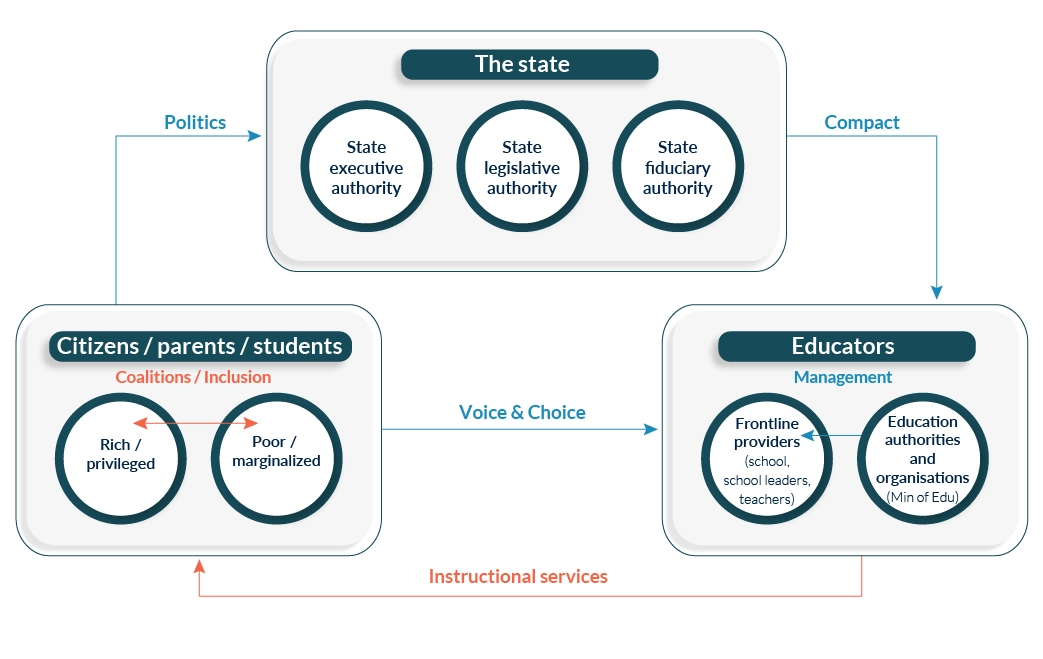
The Diagnostic is based on the RISE Systems Framework, which maps the relationships between actors in an education system and explores the effects of these relationships on systemic outcomes.
Strategic partners