BACK TO ALL NEWS
Launch of the 3rd sub-cycle on the use of evidence in education in the webinar on “Educational Management and Information Systems (EMIS) for Social Justice”.
July 18th, 2024.
18 de July de 2024
KIX
Watch the webinar
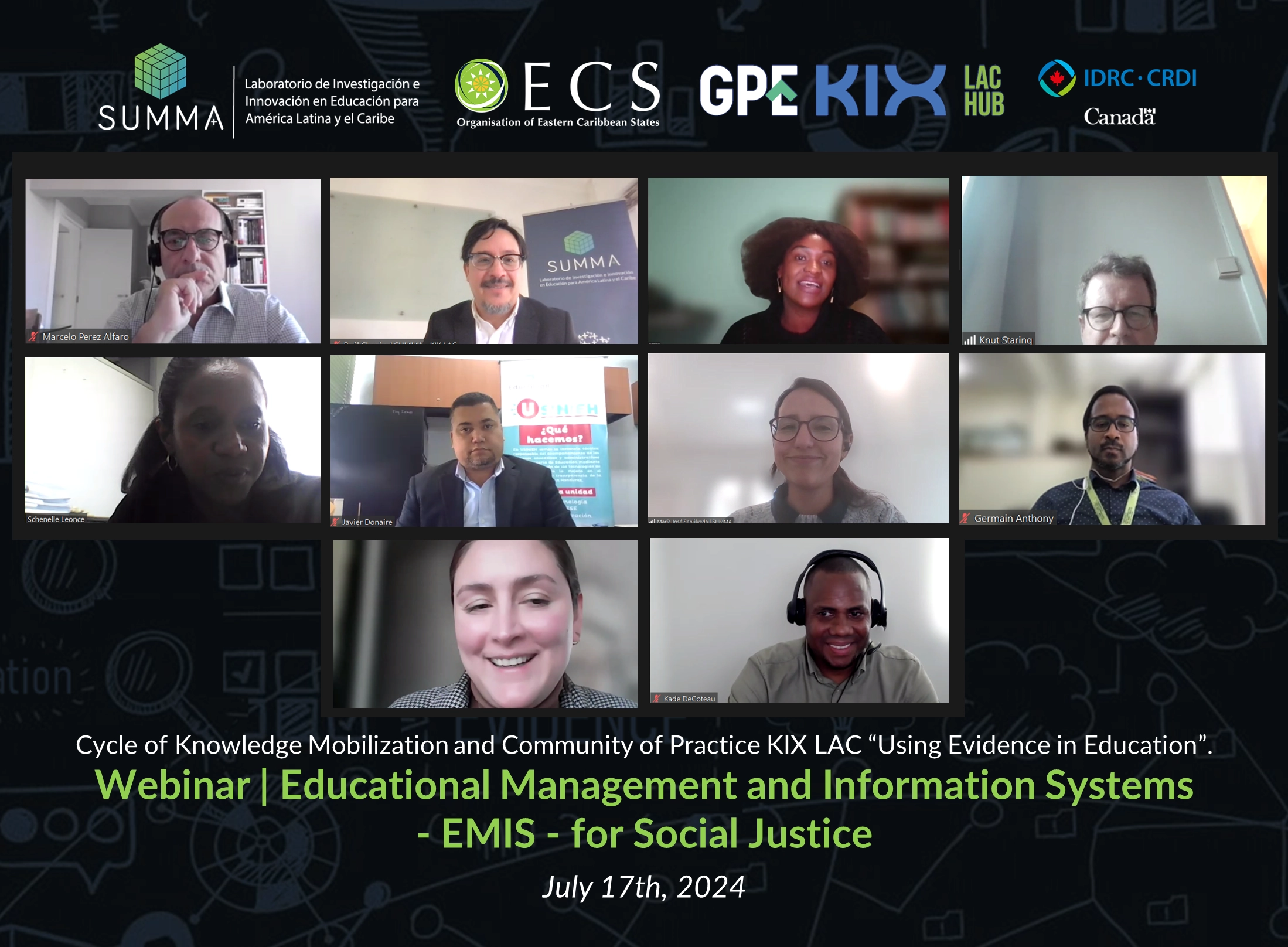
Last Wednesday, July 17, 2024, was held the launch of the third sub-cycle Educational Management and Information Systems – EMIS – for Social Justice, which closes the Cycle of Knowledge Mobilization and Community of Practice “Use of Evidence in Education” initiated in 2023. The meeting brought together international experts and education officials from Central America and the Caribbean to discuss the challenges, experiences and advantages of the use of EMIS in education.
Raul Chacón, Director of KIX LAC, SUMMA, welcomed the more than 70 participants and celebrated the joint work and collaborative agendas between Central American and Caribbean countries. He also highlighted the technical visits of the delegations from Guyana, Grenada and Bahamas to exchange lessons learned. With respect to the EMIS systems, he said “we are looking at the importance of the EMIS systems from inside the classroom and the decisions that are informed from there in terms of ensuring access, attendance and retention of students, all of which are fundamental to ensure a quality educational experience for each child.
Block 1 | Global and Regional Reflections on EMIS
Marcelo Pérez Alfaro, Lead Education Specialist and Southern Cone Focal Point del Inter-American Development Bank, presented the perspectives and challenges of EMIS in Latin America, defining EMIS as “a set of educational management processes that design, record, exploit and generate strategic online information in an integrated manner, framed by a specific legal, institutional and technological infrastructure”. Next, the IDB specialist listed the key factors of the EMIS to track and protect the trajectories, highlighting the importance that these records must be continuous until the student and the teacher complete them. These factors are:
- Have a unique record for each student.
- Have a unique indicator for each position in the school.
- Know the human resources: who they are and where they teach, support and supervise their students.
- Have a unique indicator for each building in the school systems.
- Have a unique indicator for each school.
Marcelo Pérez concluded his presentation by stating: “I believe that there is currently a growing awareness that we have to work not so much with averages but rather with each student, with each group, and that we have to move towards ever greater personalization, and to be able to do that we must have established and solid EMIS, that is extremely important”.
⬇️ Download IDB’s Presentation

María José Sepúlveda, SUMMA’s Director of Evaluation, then presented the role of the EMIS in the promotion of social justice: System for the Protection of Educational Trajectories (SiPTE) in Chile, explaining the work currently being carried out jointly by the Chilean Ministry of Education, the IDB and SUMMA. The objective of the SiPTE is to improve the permanence and progression of the educational trajectories of children and adolescents through collaborative institutional and intersectoral management based on the analysis and reflective interpretation of the data provided by the system’s platform. He also assured that this experience has yielded implementation lessons learned in terms of contextualization and local relevance; the generation of new evidence to systematize, learn and improve; data protection and information security; and the monitoring and evaluation of improvement.
Closing the first block, Germain Anthony, Technical Specialist Education at the Education Development Management Unit of the OECS, spoke about the implementation of the EMIS in the Caribbean region and some of the main challenges to be able to implement them:
- Economic cost too high to be assumed by the countries of the region.
- Infrastructure: access to devices, internet, electricity, technical capacity, etc.
- Lack of regional consensus and conflict of interest between countries.
- The need to address this issue collectively and mobilize resources to make it sustainable.
Anthony also highlighted the work being carried out by KIX LAC with respect to the two technical learning visits, one in December 2023 and the other in June to Guyana and the Bahamas, respectively, where representatives of the Ministries of Education of Caribbean countries were able to personally learn from the implementation experiences and results of the EMIS that are currently in operation: “EMIS is one of the highest priorities to be able to report effectively and on time our progress, which will allow effective decision making”, he remarked.
⬇️ Download OECS presentatios: Education Management Information Systems for Social Justice

Block 2 | Implementation of EMIS: national and subregional experiences
To start the second block, Shenelle Leonce, Education Planner of the Ministry of Education of St. Lucia, highlighted the importance of having a EMIS system that they currently lack in St. Lucia, valuing the benefits it can bring to education, including monitoring and being able to see the status of progress of the improvements implemented, commenting that “we can see firsthand that a EMIS is not just a software or a data platform, it is a system that allows a transformation of the organization”. For his part, Kade DeCoteau, teacher and representative of the Ministry of Education of Grenada, told about the first stage of implementation of the EMIS system that is currently being carried out in 9 schools in Grenada, highlighting that the main objective to fully deploy the EMIS is to collect data from students and use the attendance management system to achieve more information and real data when making decisions on educational policies.
Next, Javier Donaire, general coordinator of the National Education Information System Unit (USINIEH) of the Honduran Ministry of Education, presented the student registry, the SART module (Early Alert and Response System) for vulnerable populations, whose objective is to guarantee the right to education for girls, boys, adolescents and young people identified as at risk of dropping out or dropping out of school due to “Vulnerability Conditions or Profiles”, in order to generate an inclusive, rapid, permanent and timely response to ensure the right to education for girls, boys, adolescents and young people, in order to generate an inclusive, rapid, permanent and timely response to ensure and protect their educational trajectories; and the SACE system (Educational Centers Administration System) as the main technological tool for managing the information handled by educational centers at the national level and from which most of the country’s educational statistics are extracted.
⬇️ Download Secretary of Education of Honduras
“The information systems and educational management are not only data, they must be strategies of attention for the learners” – Javier Donaire, Secretary of Education of Honduras.

Next, Knut Staring, product manager for DHIS2 for Education at the HISP Centre of the University of Oslo, presented the process of articulating research and policy that has been carried out in African countries with relevant results from the health sector, which show the need to generate data and platforms that make it possible to demonstrate local needs. On this point and in reference to the education sector, he emphasized on capacity building, where it is needed:
- Develop strong academic and research networks.
- Establish inter-university collaborations.
- Promote academic training on a global and regional scale.
- Establish a HIPS PhD program that caters primarily to students from the global south with a practice-based research focus.

To close the meeting, Joy Nafungo, education specialist and IDRC’s KIX Africa program officer, highlighted the importance of incorporating EMIS in the different areas to ensure quality monitoring by strengthening infrastructure; the relevance of monitoring indicators to know where we are, to be able to track and reflect on progress and define how to fill the gaps; and the value of the use of technology both in the classroom and in the processes so that the flow of information is updated and permanent among the different actors.
Explore more content from the Cycle of Knowledge Mobilization and Community of Practice on “Using Evidence in Education”.
Related content



Strategic partners