BACK TO ALL NEWS
From Sobral and Ceará to Latin America and the Caribbean: Lessons to Strengthen Literacy Across the Region
May 25th, 2026.
25 de May de 2026
KIX, News
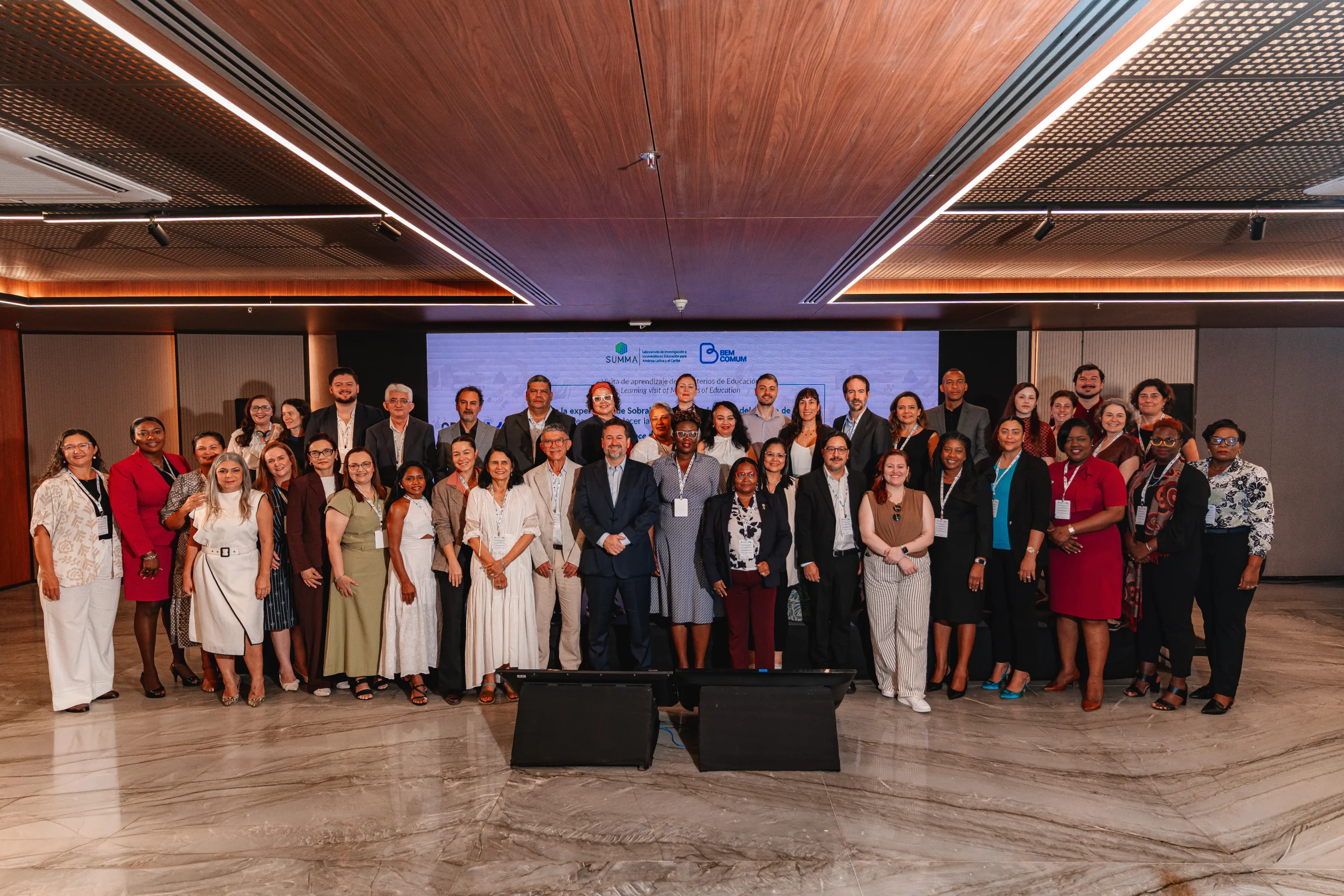
Representatives from Ministries of Education, technical teams, and key stakeholders from eight Latin American and Caribbean countries took part in a technical learning visit in Fortaleza, Brazil, with the aim of gaining firsthand insight into the experience of Sobral and the state of Ceará, both internationally recognized for their sustained progress in literacy and learning improvement.
The initiative, “From the Sobral Experience to Education Policy in the State of Ceará: Lessons to Strengthen Literacy in Latin America and the Caribbean,” was led by SUMMA, in coordination with the Latin America and the Caribbean Knowledge and Innovation Exchange Hub (KIX LAC), and co-organized with Associação Bem Comum, with support from the Global Partnership for Education (GPE), the Organisation of Eastern Caribbean States (OECS), Canada’s International Development Research Centre (IDRC), and Instituto Natura.
The activity was framed within the commitments made by different countries in the region to prioritize early literacy and strengthen regional cooperation in education, building on the Antigua Commitment promoted during the 2025 KIX LAC Regional Meeting held in Guatemala.
In a region where eight out of ten children do not reach minimum levels of reading comprehension by age 10, the meeting sought to promote peer learning, strengthen technical capacities, and support countries in the design and adaptation of evidence-based public policies.
The first day featured presentations and panels aimed at understanding the gaps and challenges related to foundational learning in Latin America and the Caribbean, as well as the key factors behind the experience of Sobral and Ceará.
Javier González, Director of SUMMA, emphasized that “humanity is capable of achieving great things when it works together” and underscored the importance of strengthening not only the pedagogical core, but also the enabling conditions for learning: teacher training, time for preparation, pedagogical support, and sustained policies.
For his part, Veveu Arruda, Director of Associação Bem Comum and former Mayor of Sobral, emphasized that “illiteracy is not a matter of destiny. It is the result of political decisions. Literacy is a challenge that transcends borders. By sharing the experience we had in Sobral and Ceará with other countries, we strengthen a learning network among governments and institutions committed to every child’s right to learn. For us, this exchange is essential to inspire possible sustainable solutions adapted to each reality.”
Raúl Chacón, Director of KIX LAC, highlighted that “it is essential to listen to where countries stand, what progress they have made, and what their priorities and challenges are, in order to understand the experience of Sobral and the state of Ceará from each context. The goal is to identify lessons that make sense and can be adapted to the realities of each country.”
The day also explored in greater depth the key elements of Ceará’s literacy policy, school financing and support schemes, and the assessment and monitoring mechanisms implemented to ensure better results.
In this context, a dialogue panel was held with Izolda Cela — Director of State Programs at Bem Comum, former Governor of Ceará, and former Secretary of Education of Ceará and Sobral —, Fábio Lisandro — Mayor of Salgueiro, Pernambuco —, and Leuzimirtes Loiola — Implementation Coordinator at Bem Comum and former school principal —, in a conversation moderated by Rafael Carrasco, Deputy Director of SUMMA. Later, João Paulo Mendes Lima — representative of Brazil’s Ministry of Education —; Jucineide Fernandes — Secretary of Education of Ceará —; and Lucas Alvino — Secretary of Education of the Municipality of Itapipoca — delved into the support and financing schemes that made it possible to implement and scale the literacy policy in Ceará and Brazil, highlighting the importance of building structural conditions that sustain effective, long-term education policies.
In addition, participants visited the Teachers’ Academy, where further discussion spaces were held to examine the pedagogical elements of the policy in greater depth, including teacher training and support, pedagogical materials, monitoring and evaluation, among others.
The second day was dedicated to observing how public policies are translated into concrete practices within schools.
The delegations visited Doutor Sérvulo Mendes Barroso School and took part in conversations with different members of the school community: school leaders, pedagogical support managers, and teachers. They also conducted classroom observations to learn about teaching strategies, pedagogical dynamics, and mechanisms for monitoring learning.
The day continued with a regional exchange session in which representatives from Ministries of Education in Central America and the Caribbean presented experiences, policies, innovations, and challenges related to foundational learning and skills. Subsequently, the delegations participated in a collaborative working session moderated by SUMMA, aimed at building a shared diagnosis of the main factors that influence the development of sustainable learning. Through dialogue among technical teams at the macro, meso, and micro levels, the session promoted joint reflection to move toward a common vision that strengthens literacy policies in the region.
The third day focused on the case of Sobral and on the role of political commitment, families, and school communities in sustaining educational transformations. Rachel Castanha, Municipal Secretary of Education of Queimadas, Paraíba; Lira Augusta, former school principal in Sobral; and Antonia Janiele Braga da Silva, mother of a Sobral student, shared experiences on how to build and maintain community engagement around early literacy.
Later, specialists from Bem Comum explored in greater depth school management strategies, curriculum development, and concrete pedagogical practices aimed at strengthening the effectiveness of the policy in the classroom. The day concluded with a final reflection session moderated by SUMMA and OECS, where the delegations worked on the development of national roadmaps to adapt lessons from Ceará to their own contexts and move toward sustainable policies to strengthen foundational learning.
During the closing session, Rafer Gordon, Head of Projects at OECS, stated that “these learning spaces help us reflect on how to drive change and continue moving toward better results. We leave inspired by the realization that there is no need to start from scratch, but rather to strengthen and improve what already exists.”
The technical visit aimed precisely to help participating countries incorporate lessons learned and strengthen their own national literacy strategies, adapted to their local realities and challenges. It is expected that this technical visit will serve as a national roadmap enabling participating countries to incorporate the lessons learned into sectoral literacy strategies. To this end, participating countries will receive post-visit technical support from SUMMA-KIX LAC, focused on translating the lessons from Ceará into concrete, sustainable actions adapted to their realities.
Learn more about the technical learning visits promoted by KIX LAC.
Related content



Strategic partners