BACK TO ALL NEWS
Launch of the knowledge mobilization cycle “use of evidence in education” and of the Community of Practice. First webinar “Using evidence for institutional change in Education”.
September 28th, 2023.
28 de September de 2023
KIX

🎥 Watch webinar | Session #1 🎥 Wacht webinar | Session # 2
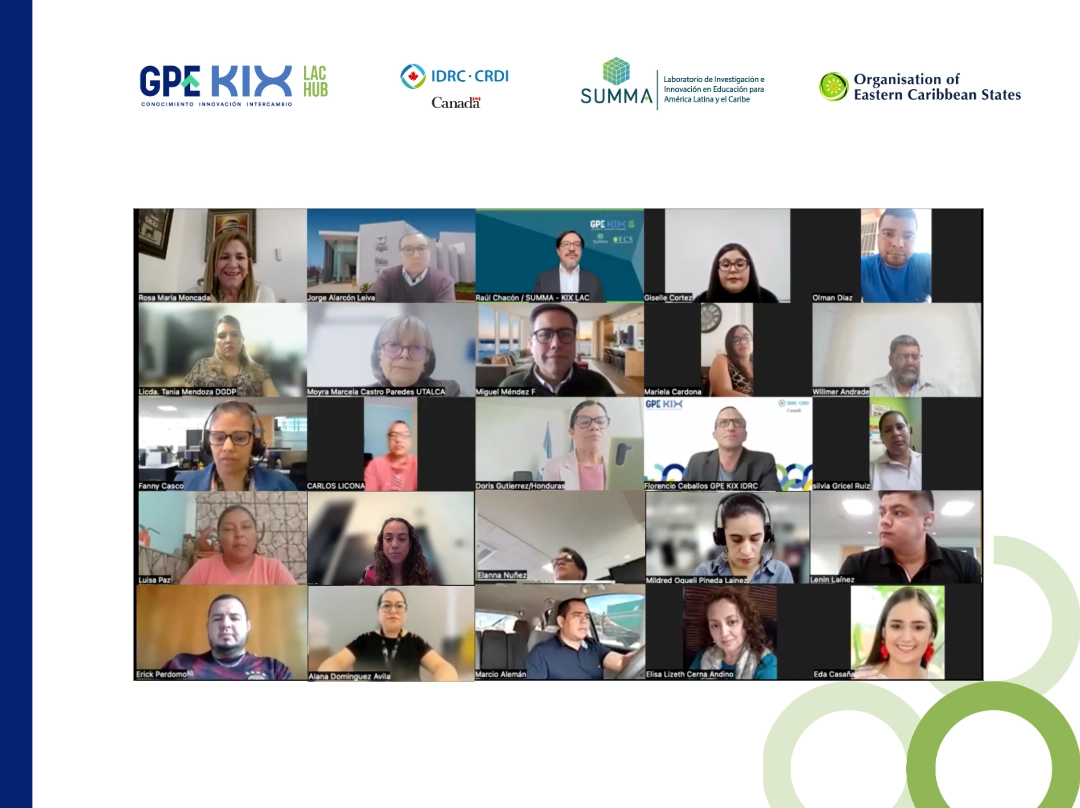
SUMMA and OECS, through its KIX LAC Center, launched the cycle of knowledge mobilization and the Community of Practice “Using Evidence in Education”.The first webinar of the cycle “Using Evidence for Institutional Change in Education” was held in the framework of the first webinar of the cycle. The virtual meeting was held on September 26 and 27, 2023, and was attended by more than 150 participants (managers and representatives of ministries of education, teachers’ unions, researchers, teachers, among others) from Latin American and Caribbean countries.
El ciclo está conformado por 3 líneas temáticas: 1. Use of evidence for institutional change, 2. Monitoring and evaluation of student learning in the context of the learning crisis, and 3. Educational Management Information and Data Systems (EMIS) for improving educational equity and inclusion. On this occasion, and to work on the first line of action, specialists from the OECD, EEF, SUMMA, Education.org, OECS, the Global Partnership for Education (GPE KIX), the Ministry of Education of El Salvador and the International Development Research Centre (IDRC), shared the work that each of the organizations has been doing on the use of research and evidence in the education sector.
Session #1
The seminar began with a welcome from director of KIX LAC, Raúl Chacón, who thanked the speakers and attendees for their interest in learning about the current situation of the use of evidence in Latin American countries and for proposing changes to the system based on the use of evidence. In this regard, he highlighted the effort being made by KIX LAC to revalue the importance of information in decision-making: “These regional discussions contribute to the construction of a stronger region in educational justice, which allows a more inclusive view of the systems and benefits the most disadvantaged populations…we need a solid knowledge base regarding what it means to use evidence and how what is out there can be used by the countri
 The panel was opened by Dr. Nóra Révai, project leader and analyst de la Organisation for Economic Co-operation and Development – OECD – who spoke about the role of research in education policy, asserting that all countries on the planet, even those rated as the best, have great challenges in education and most agree that research and evidence are very relevant to achieve improvement..
He also shared the idea that equity is one of the greatest challenges facing education todayand“Most ministries of education think that different types of research are relevant and that there is room for improvement. Teachers need to be involved and have the opportunity to engage with new research and evidence in order to understand how they can help their students learn basic skills and develop”.
↪️ Download presentation OECD
 Subsequently, Dr. Suzanne Grant Lewis, chair of Education Science and Policy de Education.org, discussed the importance of addressing the gap between knowledge and action, better addressing the need for evidence from educational policy makers. He asserted that the gap between what is known and what is actually done is at the heart of the learning crisis: “It is not the lack of new research that is the obstacle to progress but thefailure to use what we already know.”
To try to narrow the gap, Grant Lewis proposes 1) generate research promoting its use; 2) review the unpublished frontline evidence and synthesize the data. 3) have a guide for action for those who must make decisions; 4) generate an environment within the country that enables a culture to make use of the evidence; and 5) need to involve and support changes at scale.
↪️ Download presentation Education.org
 Next,Dr. Jonathan Kay, head of Evidence Synthesis de Education Endowment Foundation , then spoke about how to integrate evidence into school systems, framing the current challenges:
1. Difficulty in accessing existing evidence, both because of its availability and because of its technical and academic language.
2. Individuals/institutions choose only one or two studies that, in most cases, are not representative of the totality of research on a topic. It is necessary to see the full picture of research on a topic.
3. Movement from access to evidence to use, which should scale up effective programs; analyze the capacity in the system for everyone to receive such early intervention; train teachers; support interschool work and implementation areas; work with legislators and get additional funding, justified on the basis that the evidence achieves quality education.
Kay concluded that evidence needs to be available, accessible and actionable: “at EEF we want to develop places that contain reliable evidence where teachers, researchers and policy makers can access it free of charge”.
↪️ Download presentation EEF – Embedding evidence in education
 concluded the panel of speakers from an institutional point of view,Dr. Javier González, director de SUMMA, spoke about the mobilization of evidence for social justice, highlighting that the objective in Latin America is to have a quality, inclusive and equitable education that needs to focus on institutional change: “When we systematize the evidence and the EEF shows us the negative impact on learning, and we also know that this generates higher costs to the system, we realize that there should be no repetition, however, we see that many of our countries sustain this repetition…. The question then is: if there is an international consensus for quality education, why don’t we move forward? Why is it difficult to make the reform if the evidence says that we have to do it?”
In this regard, he pointed out that the generation of evidence in the countries of the global south is very limited, with 73% of research coming from the global north and only 16% from the global south, causing knowledge production to be very limited.
Gonzalez said that for SUMMA, as an organization that produces, synthesizes and disseminates knowledge in order to inform policy decisions and educational programs, evidence is a fundamental resource for addressing the challenges facing Latin America and the Caribbean in terms of quality learning, inclusion and equity, and emphasized that it is essential to generate institutional change (laws, norms and/or formal or informal rules of the game), a change that will only be effective if collective agreements are generated based on existing evidence and if new methods of co-production of evidence are developed where the actors involved participate in the entire process of research, design and implementation of programs.
↪️ Download presentation SUMMA – Can evidence drive reforms? How is it achieved, beyond utopias?
To close session 1, Florencio Ceballos, Senior Program Specialist IDRC – Canadá thanked the quality of the presentations and shared the work being done by IDRC on the development of a framework that understands the quality of development-oriented research: “research needs to be applied, localized and oriented towards scalability, involving local researchers as part and leaders of the teams, which rescue the current priorities of educational policies in Latin American and Caribbean countries”.
Session #2
The second day emphasized the work being carried out at the regional and local levels, exemplified by presentations by GPE KIX, the Ministry of Education of El Salvador and the Organization of Eastern Caribbean States (OECS).
 TheDr. Ian Macpherson, Team Lead del Knowledge and Innovation Exchange (GPE KIX), welcomed and reiterated the importance of strengthening a culture of knowledge sharing based on evidence and according to the demand of the countries: “The importance of evidence and data to sustain an informed dialogue and the correct implementation of innovations in education is undeniable, but it is even more important and a pillar of improvement, collaboration and exchange of experiences among actors in the sector”.
 Then,Edgar Abrego, general director of educational levels and modalities of the Ministry of Education of El Salvador, presented the “My New School” program, contextualizing the background and reasons that led to the construction of this reform: the failure to achieve improvements in the learning process, the precarious infrastructure of educational facilities, the limited coverage of kindergarten education and the abandonment of early education, the restricted access to technological resources, and the lack of effective pedagogical models, among others. Based on this diagnosis, in September 2022, a reform was created that seeks to establish a new school that allows early childhood, childhood and adolescence to learn well in a safe, pleasant and happy environment, through: a renewed curriculum, favorable technological conditions, trained teachers, access to learning tools and materials, spaces conducive to the practice of values, recreation, health and nutrition, evidence to support the reform, collection of information available throughout the ministry that provides data to indicators, review of national and international publications, and the learning process, spaces conducive to the practice of values, recreation, health and nutrition, evidence that supports the reform, collection of available information from the entire ministry that provides data to the indicators, review of national and international publications, and lessons learned from lessons and studies learned during the pandemic.
Concluding his presentation, Abrego commented that there are currently 1,143 schools in El Salvador that are in the process of validating the program, and thanks to this laboratory, it will be possible to obtain the guidelines to be able to scale the program nationally.
↪️ Download presentation Ministry Education El Salvador – Reforma educativa: MI NUEVA ESCUELA
More information about the program “Mi Nueva Escuela ” ( Design manual – Mi Nueva Escuela )
 To conclude the meeting,Nadette Langford, Senior Technical Specialist from OECS, presented the regional strategy for strengthening education data in the Eastern Caribbean countries, stating that thanks to the pandemic, they were able to realize the need and relevance of data. He also stressed the importance of generating a better alliance between the national statistics offices and the administrative part of education, where an annual projection is made to contribute to the analysis of education data, both by areas and by levels.
In this line, and thanks to the joint work of the 9 OECS member countries, the absence and need for a common regional EMIS was made visible, which makes it difficult to support students who move between islands, a situation quite common after the COVID-19 pandemic: “We need to have a monitoring system in the context of the OECS that is consistent, reliable and sustainable”.
Finally, he detailed the MERL (Monitoring, Evaluation, Information and Learning System) platform project, which he intends to be used by legislators and the administration with real-time information and analysis of education trends in the region, with performance indicators for the region at the national level, school-level data, social statistics and related indicators, because these can have an impact on student performance. The MERL project anticipates the following challenges: to be able to sustain data flows at the national level through the platform; to train education officials; to have the availability of an information and information management system (EMIS) for informed decision making; to build information capacities and know that what is being done has an impact on research; to generate an environment where research is promoted and that information sharing policies are harmonized among all participants.
At the end of the meeting, there was a space for exchange with the speakers and the attendees were invited to participate in the formation of the Community of Practice “Use of evidence in education”., which aims to address current challenges, promoting a data-based approach to improve the quality and equity in education. The community of practice will provide a space for exchange to learn from experts from international organizations, learn about experiences already applied and successful in different countries, and provide information on the subject, among others.
Do you want to join our community of practice Use of evidence in education?
In the coming days we will provide information on how to participate and the agenda of activities that will take place in the Community of Practice. More information: send an email to Mar Botero mar.botero@summaedu.org
Related content



Strategic partners