BACK TO ALL NEWS
The 4th KIX LAC Annual Meeting brings together educational leaders to share progress and plan for 2025
December 5th, 2024.
5 de December de 2024
KIX
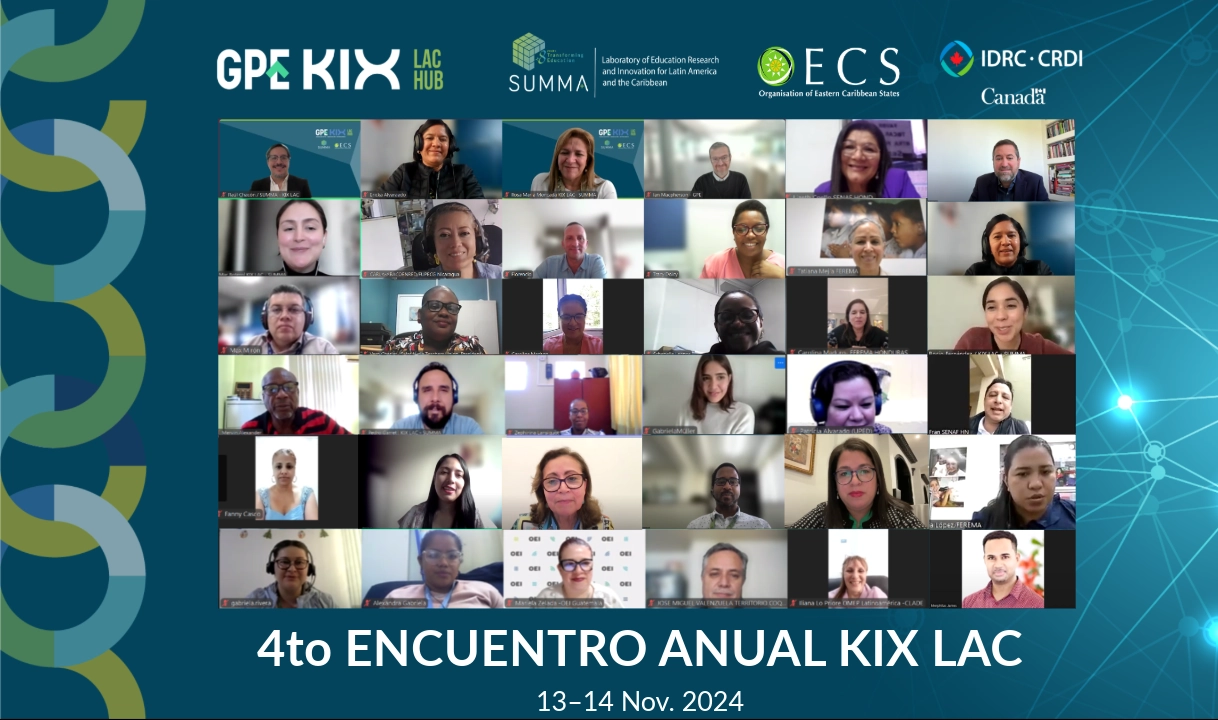
▶️Watch the video of day 1
📚 Explore the synthesis document of the meeting
On November 13 and 14, the fourth KIX LAC Annual Meeting was held, with the outstanding participation of representatives from the Organization of Eastern Caribbean States (OECS), the Global Partnership for Education (GPE) and the International Development Research Centre (IDRC) of Canada. Also present were colleagues from KIX applied research projects and delegates from the countries that make up the Latin America and Caribbean hub -including both those who have recently assumed their roles and those with an established track record- from Dominica, El Salvador, Grenada, Guatemala, Guyana, Haiti, Honduras, Nicaragua, St. Lucia and St. Vincent and the Grenadines. The meeting was also attended by specialists in early childhood education, directors, deputy directors, coordinators and presidents of different regional educational organizations.
As in previous editions, the meeting’s objective was to present the hub’s progress and achievements in the last year and agree on a work agenda for 2025, which includes the start of a new “Cycle of Knowledge Mobilization in Early Childhood.“
First day
In his welcoming remarks, Javier González, Director of SUMMA, highlighted the importance of strengthening regional collaboration among key actors in the education sector in Latin America and the Caribbean and emphasized that KIX LAC has promoted agendas defined by the countries themselves, prioritizing early childhood literacy as a pillar to address structural challenges such as school dropout and educational backwardness. He also thanked the OECS, GPE and Canada’s IDRC for their joint efforts.
The achievements and progress of the past year were then presented, including the Cycle of Knowledge Mobilization in the Use of Evidence, the Strengthening Initial Teacher Training in the Eastern Caribbean project between the University of the West Indies (UWI) and SUMMA, the Technical Learning Visits, and the Country Support mechanism.
Several representatives and key players in education highlighted through their testimonies the impact of the work carried out with KIX LAC. Some of the experiences are presented below in the voices of their protagonists:
- On the Mobilization Cycle and the importance of collaboration, Schenelle Leonce, Planning Officer of the Ministry of Education of Saint Lucia, emphasized that the visit to Guyana in December 2023 was very useful in understanding what is involved in implementing an EMIS. Guyana’s experience and action plan on EMIS allowed her to reassess her understanding of what is required to implement such a system.
- Esthefani Cerrato, Deputy Director of Educational Research, Subdirector of Educational Research, Undersecretary of Education of Honduras, commented on the technical learning visit that the Honduran delegation made to Chile in September 2023, she said it was very helpful to learn first-hand about the initiatives and effective educational policies in the Chilean education system and how this knowledge was linked to the updating of teacher training, which is still underway in Honduras. She also emphasized that it was a growing experience and invited those present to join in these visits.
- Germain Anthony, Senior Technical Specialist of the OECS Education Management Unit, stressed the importance of exchanging knowledge and promoting collaboration among educational actors and organizations. In his presentation, he shared his experience in technical visits to Guyana and the Bahamas, focused on the regional implementation of the EMIS, in which he confirmed that this system’s success requires comprehensive support, including legislative aspects and human, infrastructure and financial resources. Finally, Anthony conveyed the OECS’ request to KIX LAC to continue advancing the implementation of the EMIS in the region.
- Ana Marta Najarro, Director of Planning of the Ministry of Education, Science and Technology of El Salvador, said that the Ministry is immersed in a process of transformation of the education system, evolving from an initial focus on early childhood to a broader work on complete educational trajectories. She highlighted the support and accompaniment provided by both SUMMA and KIX LAC to educational reform in El Salvador by exchanging knowledge, experiences and best practices from other countries. In closing, she invited the countries present to join and actively participate in this collaboration mechanism.
- Next, Alana Dominguez, Director of Curriculum and Evaluation of Undersecretary of Education of Honduras, reported that Honduras has made significant progress in updating the curriculum as part of the educational refounding plan, focusing on research and collaborative action. The visit to Chile in 2022 promoted specific lines of work, strengthened this year through meetings between the Ministry of Education of Chile and the University of Talca, highlighting the signing of a letter of understanding that expands the possibilities for technical cooperation. This process reflects the importance of having partners such as KIX LAC to strengthen competencies and solidly structure the path toward a renewed education.
To close the first day of the meeting, Raúl Chacón, Director of KIX LAC, presented the projects for the coming year, such as the new Early Childhood Knowledge Mobilization Cycle, new technical learning visits, new studies on the use of evidence in Latin America and the Caribbean, and the face-to-face meeting planned for May 2025.
Florencio Ceballos, IDRC Senior Program Specialist, detailed the projects that KIX is carrying out and highlighted that in the coming years, they will be working on research projects. The main focus will be to articulate the generation of evidence with the national priorities and strategies of the countries, as well as with the work of the Latin America and Caribbean hub. The objective is to integrate these initiatives into a broader framework of development and educational policies, enhancing their impact in the region.
Finally, Ian Macpherson, Lead – Knowledge and Innovation Exchange (KIX) at GPE, highlighted the positive impact of the research and knowledge exchange that KIX LAC carries out in the region, underlining that these efforts help strengthen countries’ capacity to implement transformative reforms, optimize investments and foster the use of evidence in education policy processes.
Second day
During the second day, participants worked to define priority issues and key challenges in early childhood and identify the main gaps in knowledge about these challenges.
Welcoming remarks were made by Sisera Simon, Head of the Human and Social Division of the OECS, who highlighted the importance of early childhood education as a transformative driver for Latin America and the Caribbean, underscoring the need for equitable and quality access to break cycles of poverty and create more resilient societies. She acknowledged the region’s challenges such as socioeconomic inequalities and the gender gap, but also emphasized the potential of collaborative initiatives such as KIX LAC to promote evidence-based innovation, knowledge sharing and capacity building. Finally, she called for joint action by leaders, educators and communities to ensure that every child can reach their full potential, transforming the future of education.
Before the working sessions, a conceptual presentation was made on deepening aspects within the Cycle of Knowledge Mobilization in Early Childhood. The key topics were the importance of early education, regional diagnosis, national challenges, intersectoral collaboration and the dimensions of educational policy. The meeting also focused on quality standards, curricular frameworks, effective pedagogical practices, teacher professional development, early literacy, transition to primary education, and monitoring and evaluation.
Dr. Lizeth Coello, Minister of the Secretariat of Children, Adolescents and Family of Honduras, and institutions such as the World Organization for Early Childhood Education (OMEP) and the Organization of Ibero-American States (OEI) participated in this segment.
The following challenges were identified in the region: a lack of a curriculum led by the Ministries of Education, poor teacher training with salary limitations, low family confidence in some services, lack of intersectoral coordination, and the need for public policies to strengthen the institutional framework.
In a second moment of shared reflection, the importance of play as an essential element for child development and monitoring as a tool for accompaniment, not judgment, was highlighted. It was also considered key to involve families, define quality standards, and work on the transition from early childhood education to primary education. Regarding current challenges, the pressure on preschool teachers to achieve academic goals, the excessive use of technology at early ages and the prioritization of socioemotional learning were identified.
At the end of the meeting, the participants were thanked for the two days of work, highlighting the value of strengthening the community of practice in Latin America and the Caribbean, especially in the field of early childhood. The relevance of prioritizing efforts and aligning initiatives towards common objectives was also highlighted, as well as the need to generate spaces for cooperation between different sectors, including national governments, civil societies, teachers’ unions and academia.
Related content


Strategic partners