BACK TO ALL NEWS
The importance of data in the protection of our student’s educational trajectories
October 18th, 2024.
18 de October de 2024
KIX
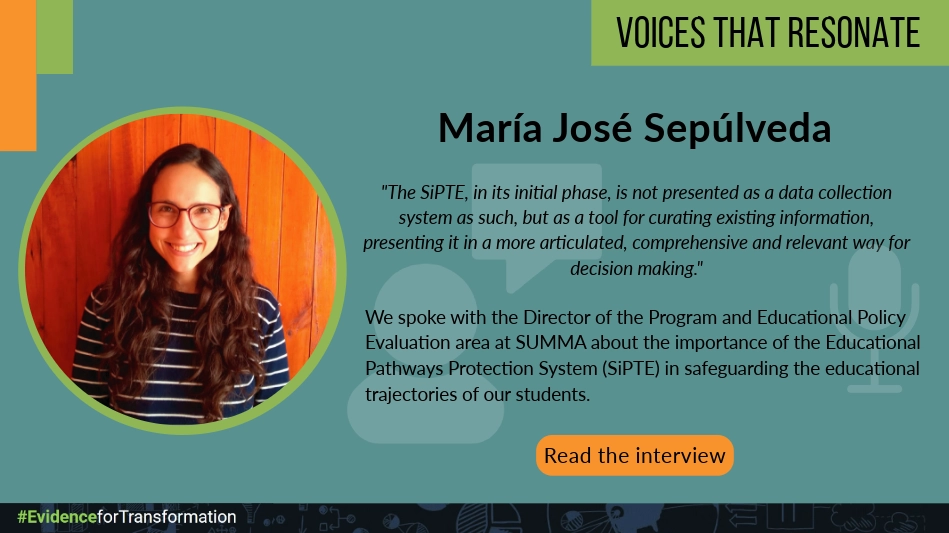
Interview with María José Sepúlveda, Director of Evaluation of Educational Programs and Policies at SUMMA, conducted by Catalina Godoy, Research and Evaluation Assistant at KIX LAC – SUMMA.
“From the installation of the SiPTE, which is aimed at articulating and making data visible for decision-making, new lessons will emerge throughout the process, which will be valuable information for the challenges the region faces today.”
María José Sepúlveda is a commercial engineer with a major in Economics and a Master in Public Policy from the University of Chile. Her professional career has focused on educational policies, and she currently holds the position of Director of Evaluation of Educational Programs and Policies at SUMMA. In this role, she designs and adapts innovative strategies to evaluate the effectiveness and relevance of educational programs and policies in Latin America and the Caribbean, to promote their scaling up. Previously, she coordinated the Statistics and Cabinet Support Unit at the Center for Studies of the Chilean Ministry of Education and was part of the Elige Educar Foundation research team.
Within the framework of the Cycle of Mobilization and Use of Evidence in Education on “Educational Information and Management Systems (EMIS) for Social Justice”, we talked with María José about the evaluation of the Educational Trajectories Protection System (SiPTE), a project that SUMMA is developing together with the Chilean Ministry of Education and the Inter-American Development Bank (IDB). Este sistema busca resguardar la permanencia y progresión de los estudiantes en el sistema educativo, tanto de aquellos en riesgo de desvinculación escolar como de aquellos que ya han sido excluidos. Mediante una gestión institucional e intersectorial basada en el análisis de datos, el SiPTE ayuda a proteger y fortalecer las trayectorias educativas de niños, niñas, jóvenes y adultos (NNJA) en Chile. The development of this system not only generates vital evidence to improve school retention in the country, but also offers valuable lessons for all of Latin America and the Caribbean.
1️⃣ | As part of the SiPTE development overview, what specific needs of the Chilean educational model does this system seek to address?
The SiPTE seeks to address a problem that, although present before the pandemic, became more urgent after the pandemic: the return and retention of students in schools. In Chile, school attendance and exclusion are historical challenges, especially among the most vulnerable populations. As an example of this, according to the SiPTE’s integrated data platform, there are approximately 33,000 school-age children out of the system. In this sense, the SiPTE acts as a backbone to integrate and articulate public policies and educational programs, making visible those students who are most at risk of exclusion.
In addition, it allows prioritizing actions and policies concerning these most critical cases. From SUMMA, we see in the SiPTE a system that contributes to make visible those students who are more vulnerable and excluded, and that also, allows focusing resources and integrating and articulating efforts, to make more relevant and efficient decisionso for the resolution of more complex cases. Although Chile has higher school attendance and access indicators than other countries in the region, exclusion continues to be a common problem in Latin America and the Caribbean. The SiPTE offers the opportunity to learn from the Chilean experience and identify strategies that can be replicated in other contexts.
2️⃣ | To better understand the functioning and impact of the SiPTE, it is crucial to examine its components and its multilevel approach. With this in mind, what are its main components and how do they operate at different levels (macro, meso and micro) to improve educational trajectories?
The SiPTE is structured in three fundamental components. The first is an articulated territorial institutional framework, which allows coordination between the different levels: from the macro, i.e. the central level, through the meso or territorial level, to the micro, which are the schools. This component establishes governance, defining responsibilities and roles of the actors involved in the protection of educational trajectories.
The second component is integrated by the visible and informed educational trajectories, which constitute the pillar of the system. Through a multilevel analytical platform, updated data is monitored and managed monthly or biweekly. This platform displays longitudinal information on what is already available in the educational system, and generates notifications or alerts based on attendance and enrollment. In addition, it produces periodic reports on critical cases, both at the level of establishments and the territory. It is important to note that the system not only issues alerts on students within schools or kindergartens, but also on those outside the educational system, activating an alert at the territorial level.
The third pillar is the capacity building for case management, both individual and global, in the protection of trajectories. This component is oriented towards training and providing resources and materials that the system offers, to improve diagnosis and guide solutions based on existing good practices. The SiPTE does not necessarily introduce something completely new, but rather compiles, articulates and orders the actions already being carried out, facilitating the prioritization of critical cases and the distribution of responsibilities.
3️⃣ | What data does the SiPTE collect and how is the quality and updating of this information ensured?
The SiPTE, in its initial phase, is not presented as a data collection system per se, but as a tool for curating existing information, presenting it in a more articulated, comprehensive and relevant way for decision-making. It works primarily with data collected by the General Student Information System (EMIS), which are available on the Open Data page of the Ministry of Education’s Center for Studies (CEM). These data will be synthesized and visualized by the SiPTE, providing a more user-friendly and accessible platform for decision-making.
In addition, the SiPTE seeks to integrate information from various entities, such as the Education Quality Agency, which provides learning results and other Personal and Social Development Indicators (IDPS). Work is also being done to include data from the Superintendence of Education, the Ministry of Social Development, the National Board of School Aid and Scholarships (JUNAEB), and Kindergarten Education, through the Superintendence of Kindergarten Education and institutions such as the National Board of Kindergartens (Junji) and Integra Kindergartens, which until now have not been consolidated in a single system. The purpose is to integrate all this information through the Ministry’s interoperability processes, with periodic updates to keep the system up to date.
SiPTE will also make it possible to systematize the information provided by the schools themselves through case management. This will generate logs associated with the students, incorporating actions, diagnoses or other additional considerations that are not necessarily in the current systems, but that can be added to their record card. Thus, the system not only works with existing information, but also integrates knowledge from other institutions and educational centers.
❝SiPTE allows different stakeholders, at macro, meso and micro levels, to access customized profiles with specific visualizations to facilitate decision making.❞
4️⃣ | Along the same lines, since the SiPTE works with different sources of information, how is interoperability between the different systems addressed, in addition to the security of the data stored by the SiPTE?
As I mentioned, this platform is basically a multilevel platform where data is presented both at an aggregated and disaggregated level, so access management and information security is key.
In general terms, the platform presents different types of access to safeguard personal and sensitive data, where it is possible to access one file per student. This type of access will be available at the level of educational establishments, and only certain profiles will have access, which today already have this responsibility due to their professional functions (head teachers, psychosocial teams and management team). On the other hand, we have access to aggregated data at the level of the course, establishment, holder and territory. These do not present a legal restriction in terms of visualization, therefore, they will be freely accessible for the different profiles. An important part of the development of this project has been the review and legal responsibility of the different users who will have access to the platform, in order to guarantee the protection and security of the use of personal and sensitive information.
Regarding information security, access will be managed through the Clave Única, a state initiative to provide citizens with a Unique Electronic Identity (RUN -Rol Único Nacional- and password) to carry out online procedures. This key will allow users to enter the SiPTE platform, associating their data to a specific profile and facilitating access and safeguarding of information. In addition, confidentiality clauses are implemented for all actions and days related to the system’s installation. The Ministry is also conducting security tests to ensure that each profile has access only to the information allowed according to its role and responsibilities.
5️⃣ | Given that differentiated information will be provided by profile, how does the SiPTE improve the ability of decision-makers to identify and respond to risks in educational trajectories?
SiPTE allows different actors, at macro, meso and micro levels, to access customized profiles with specific visualizations to facilitate decision-making. Each level receives relevant information according to its role, thus optimizing the capacity to respond to risks in educational trajectories.
In the case of educational establishments, the visualizations allow access to student records, where cases can be managed and logs can be recorded to facilitate the follow-up of actions. Through the platform, staff will be able to add information on the actions and characteristics of students, not only based on official data, but also on the knowledge acquired by the establishment throughout its experience. This facilitates more informed decision-making and allows other actors within the establishment to access the information and work together in the management of a particular case or alert.
At the territorial level, the profiles of territorial managers and reinserters, who are already working on the educational reactivation plan, will be able to access an updated list of students who are out of the system. This list will be updated every two weeks, thus making the search for cases that are actually at risk more efficient, and avoiding working with lists that were previously updated once or twice during the semester, and that did not necessarily consider the integration with all the information in the system. This generated, in some cases, that the re-linkers went to look for children and students who were not out of the system, but who had only moved from one school or city to another. The platform, by having all this information integrated, makes it possible to recognize those cases that are effectively disconnected from the system.
6️⃣ | What role do contextualization and local relevance play in the effective use of the information provided by the SiPTE?
Contextualization and local relevance play a fundamental role in the effective implementation of the SiPTE. From SUMMA and in collaboration with the Ministry, we have highlighted the importance of integrating local experiences in the development of the system. Although the SiPTE is a national system, its installation in 2024 has been designed to adjust to the specific needs of each territory. The purpose is to co-construct this system with the territories, identifying their needs and generating the appropriate support and commitments within the establishments.
Each context presents unique challenges, as the causes of non-attendance and disengagement vary considerably. For this reason, the SiPTE is currently in a design and piloting phase, focused on how to reach territorial teams and educational centers in an appropriate manner. In this process, we have held induction sessions to introduce the system to local stakeholders and strengthen their capacities.
The system is based on three critical pillars for its local implementation. First, it seeks to take advantage of and articulate existing initiatives in the territories to protect educational trajectories. Second, the provision of accessible and up-to-date data is crucial; having accurate and real-time information on attendance and linkages is fundamental to support local decision making. Finally, the SiPTE provides local teams with a number of resources and programs from the education system and state, which are essential to facilitate implementation.
In addition, SUMMA is promoting the use of available evidence on effective practices that improve attendance and retention in schools. This is complemented with a proposal for the incorporation of short improvement cycles, which guide territorial teams in the accompaniment of schools. In conclusion, contextualization is vital for the SiPTE to be relevant and useful in each territory. Although we have worked on the construction of effective decision-making models, their success will depend on the capacity of local teams to adapt and implement the system according to their particular realities.
7️⃣ | Considering the complexity of a project of this magnitude, what have been the main learnings and technical and operational challenges that have strengthened the development and implementation of the SiPTE?
Our collaboration began in 2023, with the purpose of supporting the Mineduc with the generation of evidence from an impact and process evaluation of the installation of the system. We worked collaboratively to design the logic model behind the installation of the system and saw the need to collaborate more actively in the design and activities of the installation.
In this line, one of the first challenges identified was building trust between the different teams, in order to generate a common language around the project’s purposes. Questions such as why we want to strengthen this, or where we have to contribute in terms of actions, guided our conversations in order not to lose sight of the students and to achieve the proposed indicators for this first stage of the installation.
A second challenge was to build a clearly defined governance around the System, which has been defined gradually as the installation progresses. Within this framework, in the middle of this year, a team formally dedicated to the installation and management of the SiPTE was created in the General Education Division, and between August and September, the definition of “driving teams” in the pilot territories has been promoted.
Another challenge, given the scope of a project of this magnitude, has been the need to adjust to the time frame of such an extensive national system. Implementing a platform that integrates data at this level implies a high degree of complexity, requiring thorough reviews and validations to ensure optimal functioning. These processes, although they may extend the originally planned deadlines, are essential to ensure that the information presented is accurate and that user permissions are correctly assigned, which ultimately strengthens the quality and security of the system.
Finally, another challenge faced was the crossover between the capacity building processes and the time and school calendars of the territories. The installation process has a strong pillar of awareness and accompaniment that must consider the current commitments and responsibilities of the participating territories. For example, the different contingencies of the process meant that the arrival at the schools was at the end of the year, when the schools have a heavy load.
 ❝From SUMMA, we see in the SiPTE a system that helps to make more vulnerable and excluded students visible, and that also allows us to focus resources and integrate and articulate efforts to make more relevant and efficient decisions for the resolution of more complex cases.❞
8️⃣ | Finally, we would like you to share recommendations and lessons learned for other Latin American countries undergoing similar processes. What lessons learned from the development and implementation of the SiPTE could be helpful for those seeking to improve their educational information and management systems?
We believe that several vital lessons were learned, not only in the implementation of the system but also in the coordination and articulation of the teams. En general, distinguimos tres aprendizajes principales. The first is related to the shared purposes and meanings, i.e , what the data are for, and what and how we expectthe changes we want to generate to happen. The importance of defining at an early stage what is expected from the use of data, considering the associated risks (avoiding stigmatization and additional exclusion), lies in being able to foresee actions that mitigate these risks. Here, the construction of shared meanings, the inclusion of the visions of all the actors involved and the use of information based on national and international evidence are key to more efficient and pertinent decision-making.
The second learning is related to risks and assumptions. From the system’s initial design, it is key to map as many of the risks and assumptions that may influence its implementation as possible. For example, contingencies associated with the development of the platform must be considered, ensuring not only its functionality but also the consistency, reliability and security of the information. Along the same lines, it is necessary to anticipate different implementation scenarios, taking into account the pre-existing workloads of the teams and how the implementation activities are articulated with the school calendar and the activities of the establishments. To a large extent, the actual implementation schedule, adapted to the different contingencies, has been decisive in defining what is feasible to carry out during the installation of the system, focusing mainly on the presentation, dissemination and training for its use.
Finally, a third point is articulation and coordination. Internally, it is essential to clearly establish the counterparts and designate “driving teams” at the different levels of implementation to ensure fluid and continuous communication on definitions, progress and changes, both in the implementation and in the teams in charge. In addition, it is essential to consider the workloads already assigned and to establish clear priorities, responsibilities and expectations about the implications of implementation at all levels. At the interoperability level, it is key that ministries and sectors work together from the beginning, establishing shared purposes and integrating data. This collaboration could facilitate joint work and ensure common interests for the system’s success. However, from the installation of the SiPTE, which is aimed at articulating and making data visible for decision-making, new lessons will emerge throughout the process, which will be valuable information for the challenges the region faces today.
. A nivel interno, es fundamental establecer claramente las contrapartes y designar “equipo motores” en los distintos niveles de implementación para asegurar una comunicación fluida y continua sobre las definiciones, avances y cambios, tanto en la implementación como en los equipos a cargo. Además, es esencial considerar las cargas de trabajo ya asignadas y establecer prioridades, responsabilidades y expectativas claras sobre las implicaciones de la implementación en todos los niveles. A nivel de interoperabilidad es clave que los ministerios y sectores trabajen articuladamente desde el principio, estableciendo objetivos compartidos e integrando datos. Esta colaboración podría facilitar el trabajo conjunto y asegurar intereses comunes para el éxito del sistema. Ahora bien, a partir de la instalación del SiPTE, orientado en articular y visibilizar los datos para la toma de decisiones, surgirán nuevos aprendizajes a lo largo del proceso, los cuales serán información valiosa para los desafíos que hoy enfrenta la región.

Catalina Godoy’s final words: Throughout this conversation, we saw how the System for the Protection of Educational Trajectories (SiPTE) is fundamental to address school exclusion and ensure all students complete their studies. María José Sepúlveda highlights thatdata integration and cross-sector coordination allow for effective management of critical cases, providing tools for rapid interventions that support thousands of students in Chile and have great potential for replication in other countries in the region. We thank María José for her valuable time and contributions, as well as the team that contributed to this interview: Marcelo Fontecilla, Coordinator of School Transformation at SUMMA; Magali Pérez Ryzio, Communications Manager; and Mar Botero, Knowledge Mobilization Coordinator at KIX LAC.
We invite you to learn more about the Mobilizing and Using Evidence in Education Cycle and its section on “Education Information and Management Systems (EMIS) for Social Justice” here, where we explore critical issues and foster an ongoing dialogue on best practices in education.

Related content




Strategic partners