BACK TO ALL NEWS
KIX Conversations | Towards holistic early childhood development in the region: main advances and challenges
March 20th, 2025.
20 de March de 2025
KIX
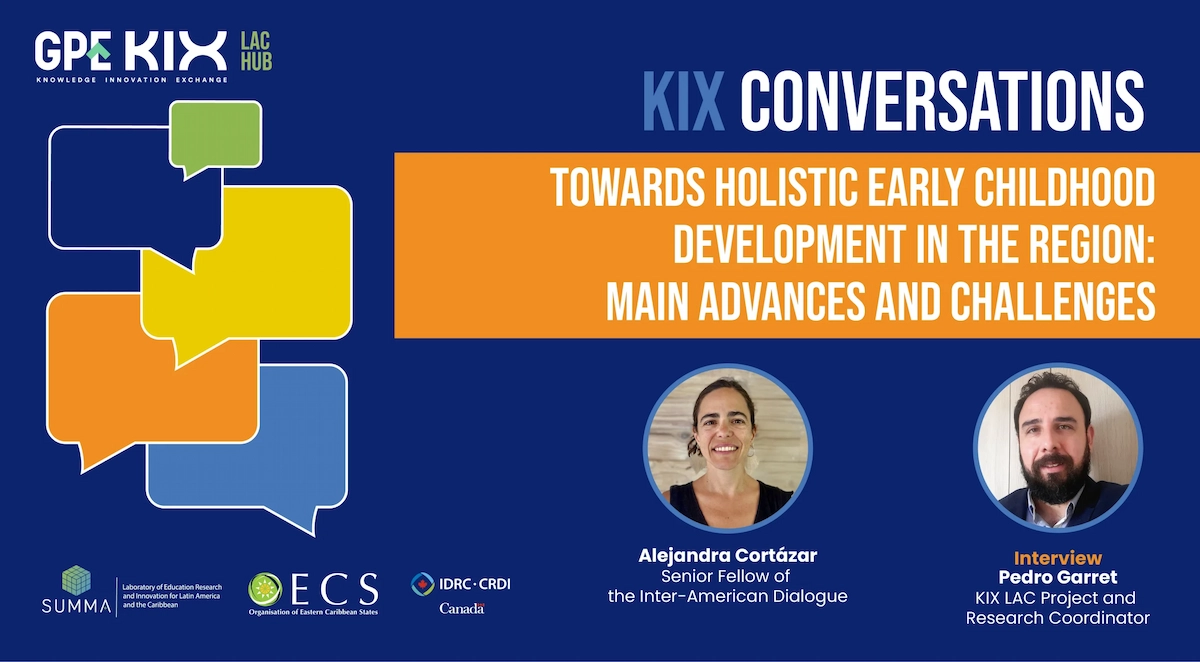
🎥 See Conversations KIX | Towards holistic early childhood development in the region (audio in Spanish)
The nineteenth edition of the KIX Conversations featured the participation of Alejandra Cortázar, Senior Fellow of the Inter-American Dialogue, who provided a detailed analysis of the main advances and challenges that exist in the region concerning early childhood education. The interview was conducted by Pedro Garret, Project and Research Coordinator KIX LAC.
Several organizations in Latin America and the Caribbean, such as the Inter-American Dialogue, have addressed early childhood education, creating an ecosystem of shared learning. In this context, KIX LAC is developing this year the “Cycle of Knowledge Mobilization: Using Evidence for Early Childhood Education Early Childhood”, bringing together representatives from the region and various organizations. The objective is to contribute to collective empowerment by exploring innovative approaches to quality, inclusive and equitable early childhood education.
The conversation began with an overview of the situation in Latin America, where children from lower socioeconomic households have approximately 40% less chance of accessing preschool education compared to those from more advantaged households. Furthermore, in rural areas and Indigenous communities, early education coverage ranges between 50% and 70%, with a marked shortage of adequate infrastructure, educational materials, and specialized teachers.
To address these inequalities, several countries have implemented alternative early education modalities. Community-based programs in Peru, El Salvador and Colombia have offered more accessible solutions adapted to the needs of families, thus expanding early childhood learning opportunities.
From the Inter-American Dialogue, a Regional Agenda for Early Childhood Development has been promoted, establishing five major key agreements:
- Multi-Sector Collaboration and Financing, for strategic investment and technical cooperation between sectors and levels of government.
- Improve the Quality of ECD Services, through assurance mechanisms for comprehensive, pertinent, and timely care.
- Measuring Early Childhood Development, with evaluation and monitoring systems to guide decision-making.
- Collaboration and Alliance-Building, through the articulation between the State, key actors and institutions, and civil society.
- Inclusion and equity, to ensure that all children are considered in early childhood policies.
Since their signing in 2017, in Bogota, several countries have worked on the implementation of these agreements. In the Dominican Republic and Chile, for example, laws have been enacted to strengthen early childhood education and protection. However, financing continues to be a challenge, since many policies lack stable budgets and depend on short-term government decisions.
Concerning quality assurance in education, in Chile the implementation of an assurance system in kindergarten education is progressing with the supervision of the Superintendency and the adoption of mandatory standards. Honduras and El Salvador developed structural standards for preschool education, while Mexico launched the National Early Education Policy, highlighting the need for a governing body and structural standards. These advances reflect a growing commitment to the quality of early childhood education; however, challenges remain, such as the lack of connection between the education and health systems, the heterogeneity of standards among providers and the duplication of actions among institutions.
A key aspect in this process has been the formation of the network “Somos Crianza”, an initiative that connects civil society organizations in seven countries: Brazil, Chile, Colombia, Ecuador, Guatemala, Mexico and Peru. Its purpose is to strengthen advocacy in early childhood public policies, promoting an ecosystem of mutual learning and joint strategies to expand impact.
Cortázar explained that this network has made significant progress by influencing decision-makers, promoting regional communication campaigns and strengthening collaboration with international organizations. These actions have been key to positioning early childhood education as a state priority in several countries in the region. In this sense, she stressed the importance of continuing to expand the network and invited more organizations to join Somos Crianza.
Finally, the specialist stressed that the regional challenge is to ensure that no country or population is left behind in strengthening early childhood education. She explained that this implies not only consolidating existing agreements but also finding mechanisms to support countries with greater difficulties in their implementation.
Looking to the future, the Inter-American Dialogue and other organizations will continue to promote spaces for collaboration and regional articulation to ensure that early childhood is a fundamental pillar of public policies in Latin America and the Caribbean. Building partnerships, sustainable investment and the generation of reliable data will continue to be key aspects of achieving significant progress in the coming years.
To learn more about the work of the Inter-American Dialogue, we invite you to explore the following resources (some only available in Spanish):
– Early Childhood Portal of the Inter-American Dialogue: https://thedialogue.org/early-childhood-development/
– Brochure on the Regional Agenda for Early Childhood Development: https://thedialogue.org/wp-content/uploads/2019/04/Brochure-Agenda-Regional.pdf
– First Progress Report on Early Childhood Policies: https://thedialogue.org/wp-content/uploads/2020/11/Politicas-de-primera-infancia-en-America-Latina-Informe-regional-de-progreso.pdf
– Second Progress Report on Early Childhood Policies: https://thedialogue.org/wp-content/uploads/2024/09/REGIONAL_Informe-de-Progreso-de-las-Politicas-de-Primera-Infancia_v03.pdf
– Progress reports by country: https://thedialogue.org/early-childhood-development-reports/



Strategic partners