BACK TO AGENDA
SUMMA presents “Human Development for All: social sciences in dialogue for inclusive societies” | Cunaco, Chile
January 14th, 2019.
Agenda, News
Ismael Tabilo’s presentation opened the first day of work in the table of Human Development and Vulnerability of Rights. He reflected on the tensions that exist in the implementation of the right to education in closed centres and provisional detention centres of the National Service for Minors (SENAME) in the Metropolitan Region.
At the time, the SUMMA researcher pointed out that “the clash between the penitentiary and educational logics causes pedagogical limitations: difficulty accessing work materials, carrying out alternative activities, leaving the room or trying out new methodologies. For the penitentiary logic, education is part of the sentence.” He added that “there is a hierarchical temporal order, where penitentiary and judicial time take precedence over school time. Thus, the activities of the detention centre set the rhythm of the day, maintaining a routine, orderly and predictable agenda. On the contrary, education in these contexts works on the basis of unpredictability and didactic flexibility in the classroom, facing the different educational levels of the students and the emotional impacts of imprisonment.”
From an individual perspective, Tabilo stated that when analyzing the trajectories of young people, different phenomena were observed that facilitated both school desertion and the beginning of a criminal career. Along these lines, he stated that “the most practical requirements of education, such as ensuring school routine (transportation, food, etc.). and the constant support and guidance for the permanence of children in schools, requires the activation of a support network that in many cases does not exist. Due to the bad previous school experiences and the early school desertion of young people, education is rather a socialized discourse, but without a social experience to support it”. In this sense, he said, “we see that going to school is not a spontaneous or significant a priori activity since, on the one hand, it mobilizes a discourse of appreciation of education that is acquired in the social and family context of early childhood, and on the other, it implies habits of behaviour that are learned in school, a period in which boys and girls make this discourse their own and build their own appreciation based on experience.”
About the meeting
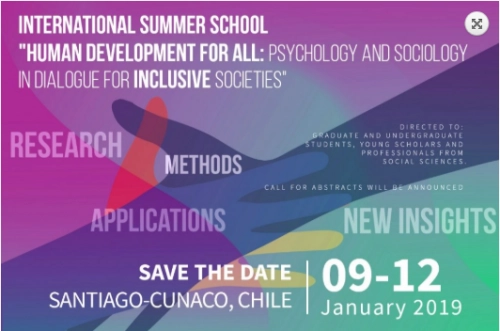
The meeting was organized by Social-One and PSY, in association with COES and the Department of Psychology of the Pontifical Catholic University of Chile (PUC). It was aimed at undergraduate and graduate students, researchers starting in academia and social science professionals, especially in the psychology and sociology fields. Participants included researchers from the ProCiviCo program of the Faculty of Psychology of the PUC, and researchers from Colombia, Mexico, Argentina, Brazil, Spain, Italy, among others. Ten psychology and sociology researchers from the universities of Genoa, Aldo Moro de Bari and Sapienza in Rome attended as representatives of the Social-One network.
More information here

Related content

Strategic partners