BACK TO ALL NEWS
Workshop on how to build diagnostics and strengthening plans for the EMIS in Latin America and the Caribbean was held
October 2nd, 2024.
2 de October de 2024
KIX
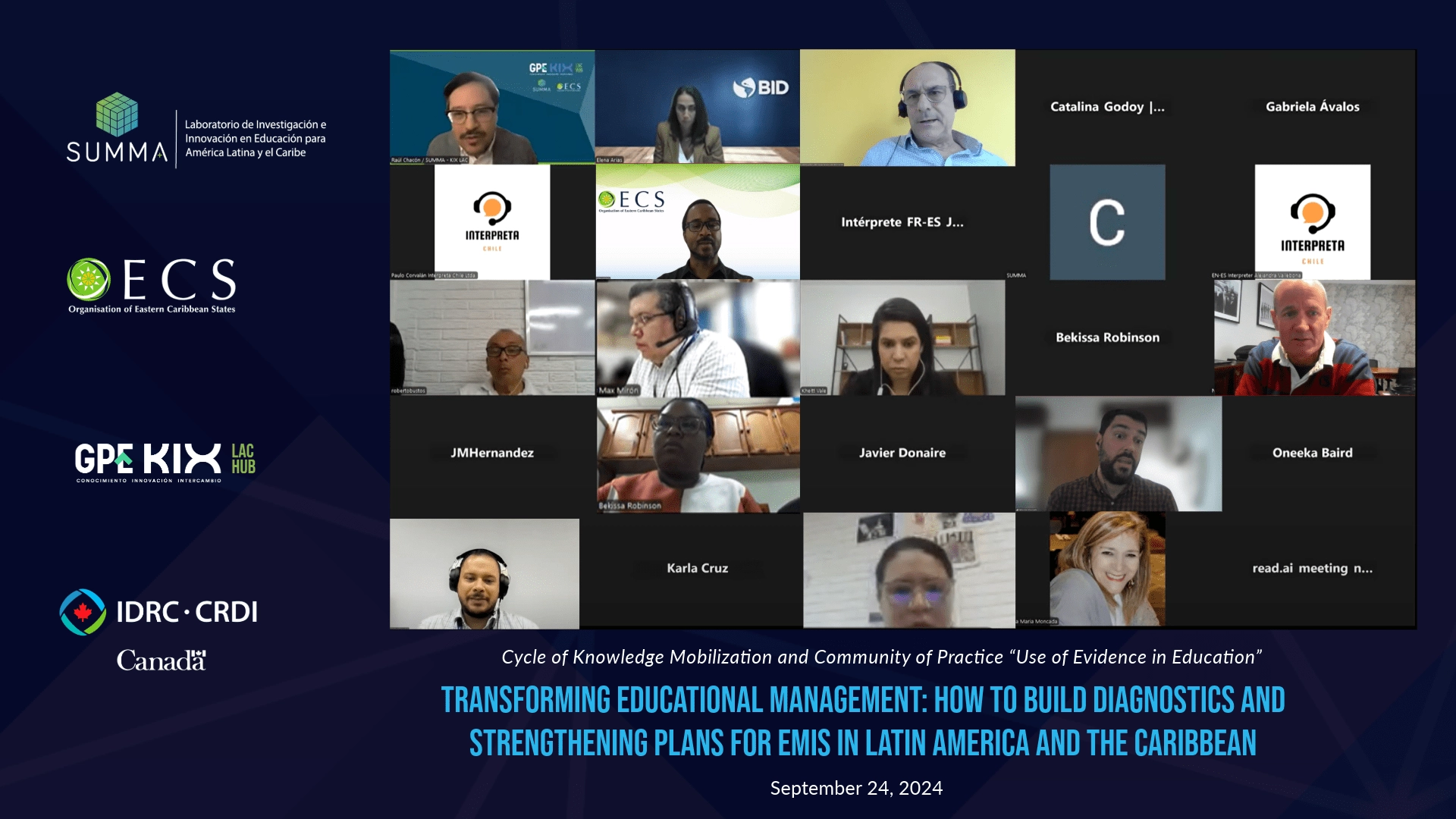
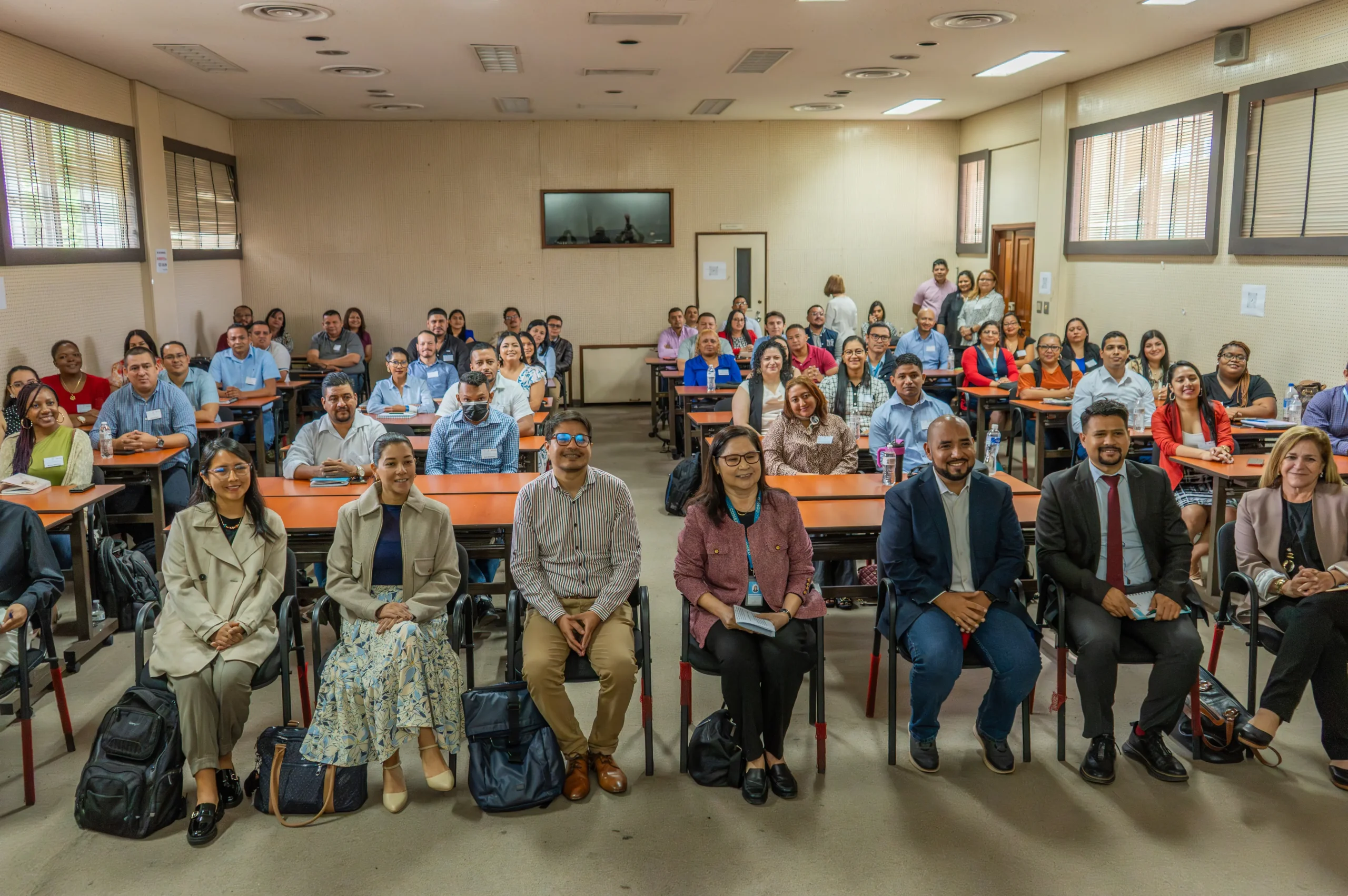
SUMMA – KIX LAC, with the support of the Global Partnership for Education (GPE) and the International Development Research Centre (IDRC), and in coordination with the Inter-American Development Bank (IDB), organized the workshop “Transforming Educational Management: How to build diagnostics and strengthening plans for Education Information and Management Systems (EMIS) in Latin America and the Caribbean”, which marks the closing of the Cycle of Knowledge Mobilization and Community of Practice “Using Evidence in Education”, which began almost 1 year ago and aims to address current challenges in the region and promote a data-driven approach to improve educational quality and equity. This workshop sought to provide practical tools and expertise to enable stakeholders to apply EMIS diagnostics and design effective strengthening plans, thus contributing to the transformation of education in the region.
Raúl Chacón, Director of KIX LAC, welcomed those present, including statisticians, IT and planning professionals from the Ministries of Education of the 10 countries that are part of KIX LAC (Dominica, El Salvador, Grenada, Guatemala, Guyana, Haiti, Honduras, Nicaragua, St. Vincent and the Grenadines, and St. Lucia). As introductory words, he emphasized the satisfaction of continuing and deepening the dialogue, exchanges and lessons learned, especially in the context of the Knowledge Mobilization cycle. He also emphasized the importance of the EMIS as a tool for social and educational justice, since it must act in a timely and efficient manner to ensure the right to education of every child and young person.
Elena Arias Ortiz, Senior Education Specialist at the Inter-American Development Bank (IDB), presented the study “Digital Transformation of Educational Management”, which addressed the current challenges facing education in Latin America and the Caribbean. In response to this situation, she stressed the importance of focusing on two main areas: pedagogical transformation, with a focus on 21st century skills, and improving the management and efficiency of spending, prioritizing effective processes and the use of integrated and updated digital information.
On the other hand, Arias Ortiz explained the key aspects to achieve a high-impact SIGED, highlighting the value of having a single registry of buildings, schools, human resources and students, as well as adequate data management. The analysis of these processes and structural conditions allows measuring the maturity level of the SIGEDs, classifying them as latent, incipient, emerging or established. Subsequently, she pointed out that in order to strengthen these systems, it is essential to carry out a diagnosis that identifies both obstacles and strengths, adapting them to specific needs and contexts, and maintaining an integral vision.
In the second part of the meeting, Marcelo Perez Alfaro, IDB Lead Education Specialist, moderated a panel to exchange experiences on the implementation of the EMIS Diagnostic Tool, where the challenges and achievements in countries such as Brazil, Barbados and Jamaica were discussed. The panel was integrated by Kheitt Silva Vale, Master in Administration at the Getulio Vargas Foundation (FGV); Neil Butcher, Open Educational Resources Strategist at OER Africa and collaborates with the World Bank and the IDB in projects in Africa, Asia and the Caribbean; and Elena Arias Ortiz (IDB).
Kheitt Silva, during his speech, shared the experience of implementing, together with the Getulio Vargas Foundation (Brazil) and the Secretariat of Education, the EMIS Diagnostic tool in the city of Paraná, Brazil, where 2,100 schools are located. In 2020, the city’s main need was to guarantee a quality educational offer for all students and to have concrete data on educational management. The EMIS Diagnosis tool contemplated the performance of self-evaluations and evaluations guided by technicians, and provided the necessary indicators and information. She also highlighted that among the advances achieved between 2020 and 2022 were: improved communication between the departments of the secretariat, the creation of a project management team to map processes derived from the use of EMIS, the development of manuals to document these processes, the creation of a pedagogical management department for schools, and the development of educational platforms.
Neil Butcher, based on his work in Barbados, recommended focusing on the diagnostic phase to obtain a comprehensive view of the challenges of SIGED. He noted that the tool is effective in identifying the greatest challenges and thus focusing work on key areas, and that a new diagnostic review is planned in three years to assess progress. Finally, he stressed that the EMIS Diagnosis tool facilitates a systematic process as it considers all elements, consults stakeholders and uses the data obtained to plan the strategy, avoiding relying only on individual opinions or knowledge.
Elena Arias Ortiz commented on her work with Jamaica that began before the pandemic. At that time, the evaluation conducted using the IDB’s EMIS diagnostic tool revealed that the Ministry had challenges in monitoring how schools managed their financial resources and in recording data. Thanks to this knowledge, they are now implementing a financial management system for schools to record expenditures and then upload the information to a platform that will be accessible to both schools and the Ministry, facilitating decision making at every level of the education system.
Sebastián Iturralde, Manager of the Economics Department of CPA Ferrere, shared his experience on the challenges faced by the EMIS improvement plans, emphasizing the importance of adopting a global and comprehensive vision of transformation, and offering key recommendations and considerations for its implementation. Some of the suggestions at the time of making the plan include ensuring political support for its implementation, defining actions structured in components that address specific objectives and mapping available financial, personnel and technological resources. Finally, its implementation should be carried out in stages, adapting to the resources and capabilities of the teams.
At the end of the workshop, Germain Anthony, Technical Education Specialist of the OECS Educational Development Management Unit, shared his perspective on the implementation of EMIS in the Eastern Caribbean, where given the size of the population and the limited financial resources of the countries, they adopted a regional approach to drive initiatives as a block and strengthen capacities to advance educational planning. A technical working group was formed to develop the implementation and identify the best solutions available for the region, highlighting the OpenEMIS platform (an Educational Management Information System designed to manage individual student data) and knowledge sharing with KIX LAC through learning visits.
📍 Explore more content from the Knowledge Mobilization Cycle and Community of Practice on “Using Evidence in Education”
📍To receive more information on the topic, you can update or add your data by completing this survey.
Related content


Strategic partners