BACK TO AGENDA
SUMMA exhibits at the 5th Interdisciplinary Congress on Research in Education, organized by the Chilean Association of Researchers in Education
August 22nd, 2019.
Agenda, News

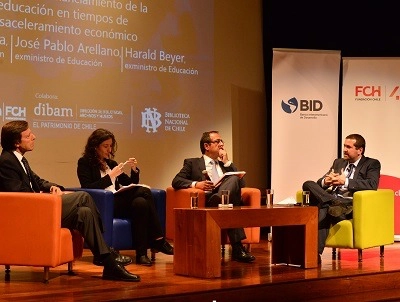
The fifth version of the Interdisciplinary Congress on Research in Education, organized by the Chilean Association of Researchers in Education, was held on August 20-22. This year’s meeting focused on the challenges of diversity and the demands for a less segregated education system, with national and international experts.
SUMMA actively participated in this Congress: first, researcher Ismael Tabilo, talked about the book Ecosistemas de I+D+i en educación en América Latina, which was elaborated in network with eight countries of the region and will be edited by SUMMA. On the third and final day of the meeting, Dante Castillo-Canales, Director of Innovative Policies and Practices, spoke about causality in educational research.
Ecosystems in R&D+i
Tabilo pointed out that, “the link between education and innovation has been fruitful, but its implementation is fragmented, disconnected or superficial.” He added that in the countries analyzed, “the national innovation systems have focused their research applied to production sectors -agriculture, mining and silviculture-, postponing their attention on education” and that “the programs that promote R&D+i in education are scarce, promoted mainly by the third sector, and the topics are generally decided from academia, without considering the needs of school communities.”
One of the main conclusions of the study of R&D+I ecosystems is that educational innovation in Latin America has been understood mainly as material improvement, introduction of technology and digital literacy in school communities, taking away space from interventions such as normative-reeducational ones (reformulation of values and attitudes) or political-administrative ones (reformulation of the objectives and functions of the education system).
Causality in educational research
On the third and final day of the meeting, Dante Castillo-Canales, Director of Innovative Policies and Practices, will speak on “Causality in Educational Research: methodological limitations of the evidence-based approach”. The paper addressed the concept of causality used by the evidence-based policy and practice approach promoted by educational research. This perspective privileges experimental designs such as Randomised Control Trials (RCTs). This model operates on a theory of limited causality based on the notion of regularity or systematic association among variables or events. In his paper, Castillo-Canales recognized the merits of experimental designs, but discussed their limitations in explaining complex social problems and proposed an alternative causality model linked to the notion of plural causality developed by Philip Gorski (2015).
About CIIE Congress
The meeting aims to invite academia and education researchers to provide interdisciplinary responses to the challenge of decreasing segregation in the education system. In a context of multiple cultural, gender, indigenous and national identities, demands for a less segregated system and challenges of a promising and complex future, this meeting proposes to raise the questions and identify the challenges that should mark the future educational research agenda.
The activity will take place at Universidad Católica Silva Henríquez.
More information and program details here

Related content



Strategic partners