Dialoga – From Synthesis to DecisionEvidence synthesis for education decision-making in Latin America and the Caribbean
Strengthening a culture of evidence and system capacities to connect educational needs and policy priorities, identify knowledge gaps, synthesise evidence, and support education policy decision-making in Latin America and the Caribbean.
SUMMA, the Laboratory for Education Research and Innovation in Latin America and the Caribbean, in articulation with the KIX LAC Hub and the Evidence for Education Network (EEN), in collaboration with the Organisation of Eastern Caribbean States (OECS), eBASE Africa, and the Education Endowment Foundation (EEF), leads a regional initiative within the framework of the Knowledge and Innovation Exchange (KIX) programme of the Global Partnership for Education (GPE), with support from the International Development Research Centre (IDRC).
Dialoga seeks to strengthen the use of evidence in education decision-making, contributing to KIX and GPE regional efforts to promote a culture of evidence and to connect countries’ educational needs and policy priorities with processes of evidence synthesis, applied learning, and mobilisation for action.

What is the From Synthesis to Decision initiative?
Starting in 2026, SUMMA, in articulation with the KIX LAC Hub and eBASE (a partner within the EEN network), will implement Dialoga: Evidence for Education Decision-Making, a regional initiative aimed at strengthening demand-oriented evidence systems for education policy in the Global South.
The project seeks to improve the quality and timeliness of education decision-making by strengthening capacities to analyse knowledge gaps, synthesise relevant evidence, and use it effectively within education policy processes.
Dialoga responds to a shared challenge across education systems in Latin America and the Caribbean: while there is a growing volume of available evidence, it does not always align with policy priorities, nor is it presented in formats, timelines, or languages that facilitate its use by decision-makers.
In this context, Dialoga proposes a collaborative national and regional prioritisation process to identify evidence gaps and strengthen system capacities to respond to them through rigorous synthesis and applied use of knowledge.
The initiative focuses on strengthening system capacities to:
- identify education policy priorities relevant to the region and analyse existing knowledge and evidence gaps;
- translate these gaps into research and evidence synthesis questions that are relevant and answerable;
- conduct rigorous and contextualised evidence syntheses, using traceable and replicable methodologies; translate synthesis results into inputs that are useful for public action.
Why put synthesis at the centre?
Improving the use of evidence does not depend solely on generating more knowledge, but on strengthening system capacities to search, organise, synthesise, and use existing knowledge as a meaningful input in decision-making processes.
In many Global South contexts, academic research capacity is limited, and systems rely heavily on evidence produced in the Global North, generating asymmetries and misalignment with local realities. Dialoga strengthens local capacities to understand, synthesise, and use evidence, articulating global knowledge, regional evidence, and institutional know-how.
In this sense, evidence synthesis acts as a bridge between research, policy design, and implementation, contributing to KIX and GPE efforts to strengthen a culture of evidence use within education systems.
How does the project work?
The initiative is structured around three articulated lines of work, which connect national and regional education policy priorities with the identification of evidence gaps, the formulation of research questions for evidence synthesis, and the development of relevant products to support public decision-making.
Throughout the process, evidence mobilisation accompanies the work, ensuring the production of concrete, relevant, and timely inputs for decision-making.

1
Policy priorities and knowledge gap mapping
+ info
2
Evidence gaps and synthesis
+ info
3
Community of Practice for evidence use and solution development
+ info
4
Evidence mobilisation
+ info
Why join Dialoga?
Education decision-making in Latin America and the Caribbean faces complex challenges, tight timelines, and fragmented evidence. In many cases, the challenge is not the lack of studies, but the difficulty of connecting policy priorities with usable, synthesised evidence available in time to inform decisions.
Dialoga offers a regional collaborative space to operationalise education policy priorities through evidence, transforming knowledge gaps into research and synthesis questions and producing concrete inputs that support public decision-making.
How to participate
Participation in Dialoga is selective and structured, and takes place through an annual collaborative work cycle that combines regional engagement with applied country-level work.
The process includes:
- participation in the identification and analysis of knowledge gaps linked to education policy priorities;
- engagement in a regional Community of Practice, focused on formulating research and evidence synthesis questions, analysing existing knowledge, and translating it into decision-relevant inputs;
- contribution to the development of regional public goods, such as evidence syntheses, guides, and practical resources to support policy decisions.
The initiative prioritises peer learning, applied work, and the development of products that can be used and adapted by other countries and actors across the region.
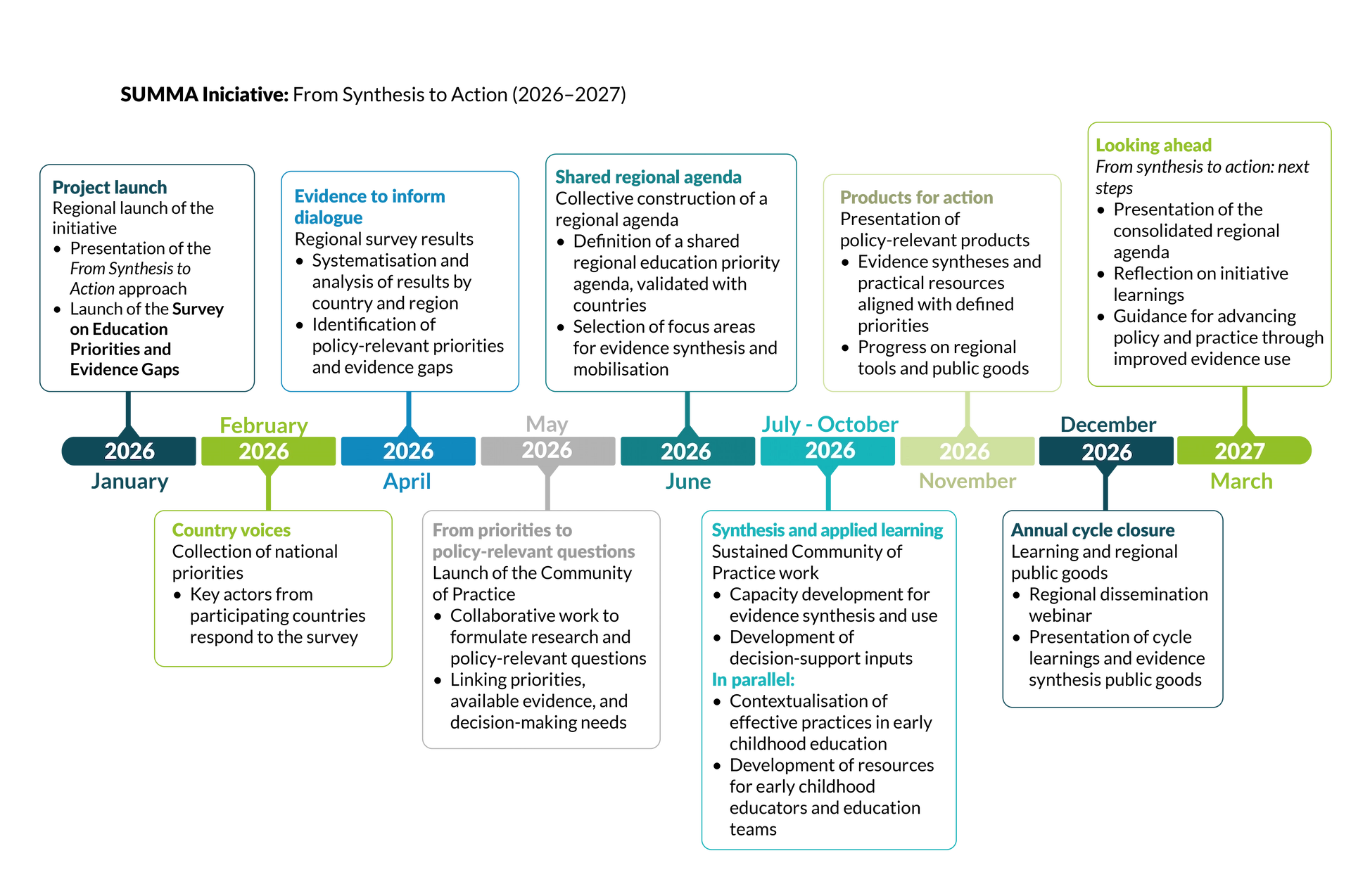
Timeline: Phases and key milestones