BACK TO ALL NEWS
2️⃣ | For this change to be truly sustainable, we must also ask ourselves at what age to begin: your baseline research shows that gender biases are present as early as age 5. In a regional context striving for equity, How does this finding shape the urgency of early childhood intervention, and what does it mean for Ministries of Education to know that schools may be reinforcing these gaps from the early grades?
4️⃣ |However, transforming these practices depends largely on school staff, and this presents another challenge: the results from the project’s first year indicate that 3 out of 4 teachers feel they lack the necessary tools to change the culture of violence and/or exclusion in their schools, and many lack the confidence to address gender-based bullying. What kinds of professional support, practical tools, and peer learning opportunities help teachers feel more confident and effective in creating inclusive classrooms?
5️⃣ | Furthermore, an interesting gap can be observed among the teaching staff: secondary school teachers are more aware of gender inequalities than primary school teachers. To what do they attribute this difference in perception, and how are they working to ensure that staff at all levels recognize these “invisible biases” before they lead to students dropping out of school?
Evidence for Equity: Lessons from Caribbean Schools
June 4th, 2026.
4 de June de 2026
KIX
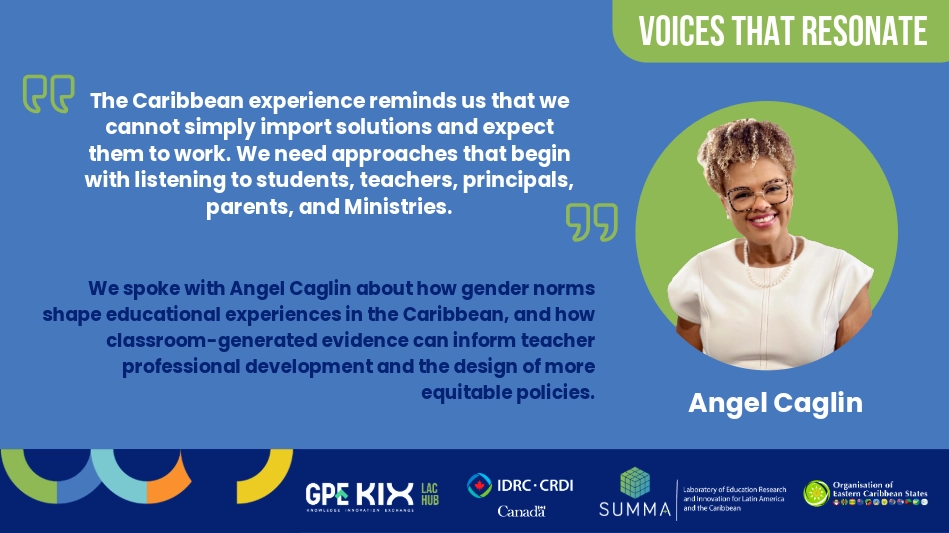
Interview with Angel Caglin, Executive Director of the Caribbean Innovation & Leadership Lab (CILL), conducted by Catalina Godoy, Research and Evaluation Assistant, KIX LAC – SUMMA.

❝ Equity is about ensuring both boys and girls are supported to reach their full potential ❞
Angel Caglin is the Executive Director of the Caribbean Innovation & Leadership Lab (CILL) and the lead of the project funded by the Global Partnership for Education (GPE) KIX Initiative, titled “Capacity Building for Gender Equity and Inclusion in Caribbean Schools”, or Full Potential. Implemented since 2024 in Saint Lucia, Dominica, and Saint Vincent and the Grenadines, the project aims to strengthen gender equity and inclusive education in schools across the region through capacity building, educational innovation, and the generation of evidence to guide educational policies and practices.
The initiative was launched in response to persistent challenges in the Caribbean, particularly gender gaps that manifest in lower academic achievement among boys, higher dropout rates, and lower secondary school graduation rates. To address these issues, it adopts a whole-school approach that simultaneously and coordinately involves all stakeholders in the educational community: ministries of education, teachers, school leaders, students, and families. This approach combines teacher professional development, the strengthening of school leadership, and an innovation strategy led by the Ministries themselves, with the aim of promoting inclusive leadership, improving learning outcomes, and collecting data to inform more equitable policies and practices.
The report on the first year of implementation shows that gender norms—understood as perceptions, stereotypes, and social roles that dictate how boys and girls should behave—are present from the earliest grades. They manifest in deeply held beliefs about gender roles among students, in disciplinary differences based on sex, and in significant gaps in teachers’ confidence in addressing inclusion in the classroom. In the second year, whose report will be available soon, the program moved from assessment to action, exploring how to translate that evidence into concrete changes in teaching practices, school leadership, and the design of education policies.
As part of the “Voices That Resonate” series and its Knowledge Mobilization Cycle on the Use of Evidence inTeacher Policies and Practices, Angel Caglin and Catalina Godoy reflect on how these gender norms shape the educational experience in the Eastern Caribbean and what changes schools can drive to reverse them. The conversation explores how evidence generated in the classroom can guide both teacher professional development and the design of more equitable systemic policies, to build educational systems where every student, regardless of gender, can fully realize their potential.
1️⃣ | The underperformance of boys is a long-standing issue in the Eastern Caribbean. Given that the project links this gap to norms of masculinity, what distinguishes the whole-school approach from traditional policies, and why is community-wide involvement key to sustainable change?
The underperformance of boys in the Eastern Caribbean is not a new concern, but one of the things the Full Potential Program is trying to do is move the conversation beyond simple explanations. It is not enough to say that boys are underperforming because they are boys, or because they need a different teaching style. Our work looks at the wider set of norms, expectations, relationships, and school practices that shape how boys and girls experience education.
The distinctive feature of the whole-school approach is that it does not locate the problem in one group by referring to it as “a teacher problem,” or “a boys’ problem,” or “only a Ministry policy problem.” Instead, it recognizes that gender norms are reinforced across the whole school environment: in classroom interactions, discipline practices, peer relationships, leadership decisions, curriculum materials, and even in the informal messages children receive about what boys and girls are expected to do.
That is why the Full Potential Program works with teachers, principals, and Ministry officials. Teachers collaborate to explore and test solutions in their classrooms. Principals support teacher innovation, align it with school improvement priorities, and help communicate learning across the system. Ministry staff help set innovation priorities and support promising solutions to move toward scale.
Sustainability benefits from that shared ownership. A policy can set direction, but it cannot by itself change everyday practice. A teacher can make changes in one classroom, but those changes are stronger when school leadership protects time, encourages reflection, and supports consistency. Ministries can use evidence from schools to inform professional development, planning, and policy. So the whole-school approach creates a bridge between evidence, practice, leadership, and system-level decision-making in order to make sustainable change possible.
2️⃣ | For this change to be truly sustainable, we must also ask ourselves at what age to begin: your baseline research shows that gender biases are present as early as age 5. In a regional context striving for equity, How does this finding shape the urgency of early childhood intervention, and what does it mean for Ministries of Education to know that schools may be reinforcing these gaps from the early grades?
The finding that gendered ideas are present as early as Grade 1 is one of the most important signals from the first year of research. In Year 1, the project collected data from Grade 1 students through a one-to-one activity and from Grade 6 students through surveys. The Grade 1 data showed that children already held highly gendered views about toys and occupations, with strong consistency across responses. For instance, students believed that women, rather than men or both men and women, would want to be a doctor or a teacher .The report notes that this suggests gender norms were commonly and consistently understood by children by age five.
We have to interpret that finding carefully and fairly. By age five, children have already absorbed many messages from home, family life, community, media, religion, peers, and the wider society. Schools are not solely responsible for creating these norms. At the same time, schools are powerful social spaces, and they may unintentionally reinforce gender expectations through everyday routines: the examples used in lessons, how classroom tasks are assigned, what behaviours are encouraged or corrected, what boys and girls are praised for, what toys or activities are seen as appropriate, and how adults respond when children cross gendered expectations. The finding shows that gender norms are formed across a child’s whole environment. The role of the school is important because it is one of the first public institutions children enter, and it can either narrow or widen their sense of what is possible.
That informs the urgency of early intervention. Equity work cannot wait until secondary school, when gender norms may already be showing up through peer pressure, subject choices, bullying, discipline patterns, disengagement, or dropout risk. Early childhood and primary classrooms are key spaces for gently expanding children’s ideas about themselves and others.
For Ministries of Education, the implication is that equity and inclusion should be integrated into early childhood curriculum, teacher preparation, classroom materials, school leadership, professional development, and parent engagement. Schools cannot do this work alone, but they can be strong partners with families and communities in helping boys and girls grow with dignity, confidence, and a wider sense of possibility.
3️⃣ | These biases, which take root at an early age, are also reflected in day-to-day interactions within the classroom. One of the findings in your reports is that both boys and girls agree that boys receive more physical punishment and harsher treatment from teachers. How might these experiences affect boys’ motivation to attend and complete school?
The student data gives us an important window into how children are experiencing school. In the Grade 6 data, boys and girls reported that students are treated differently because of gender. Some of these differences related to classroom tasks and activities, but the report notes that most of the differences students identified were related to discipline. Girls reported that boys are treated more harshly, and students described situations where teachers yell or shout at boys but speak more calmly to girls. Boys and girls across all three project countries also reported boys receiving corporal punishment, using phrases such as “boys got licks” and “boys get more beatings than girls.”
We have to treat these student perceptions seriously. They do not mean that teachers are intentionally trying to harm boys. Teachers are working in complex classroom environments, often with limited support. But when boys repeatedly experience school as a place where they are more likely to be blamed, shouted at, punished, or physically disciplined, it can affect their relationship with school.
Motivation is not only about interest in subject content. It is also about belonging, dignity, trust, and whether students feel that adults see them as capable of doing well. If a boy begins to believe that teachers expect him to misbehave, or that school is a place where he is always in trouble, he may disengage emotionally before he disengages physically. That can influence attendance, effort, participation, and persistence over time.
The Full Potential Program is using these findings to open professional dialogue among educators. The goal is to help schools ask better questions: Are discipline practices building accountability and growth? Are they strengthening relationships or weakening them? Are boys receiving the support they need to regulate behaviour and remain connected to learning? The progress we are working toward is a school culture where correction is firm but respectful and boys and girls are held to high expectations. Discipline should keep students connected to school rather than pushing them away.

❝ Schools are powerful social spaces, and they may unintentionally reinforce gender expectations through everyday routines ❞
4️⃣ |However, transforming these practices depends largely on school staff, and this presents another challenge: the results from the project’s first year indicate that 3 out of 4 teachers feel they lack the necessary tools to change the culture of violence and/or exclusion in their schools, and many lack the confidence to address gender-based bullying. What kinds of professional support, practical tools, and peer learning opportunities help teachers feel more confident and effective in creating inclusive classrooms?
The Year 1 findings show that teachers themselves recognize the need for more support. Only 35 percent of teachers said they could confidently identify students in their classroom who were struggling and provide appropriate support. One third of teachers said they needed additional capacity building to better understand and implement principles of gender, equity, and inclusion. Almost half said they were not confident and prepared to respond to bullying and sexist language in their schools.
I think it is important to interpret those findings carefully. A lack of confidence is not the same as a lack of commitment. Many teachers care deeply about their students, but they are being asked to respond to very complex issues: bullying, exclusion, gender stereotypes, student wellbeing, violence, and social norms that extend beyond the school. These are not issues that can be solved by goodwill alone.
Teachers need practical, sustained, and collegial support. First, they need professional dialoguethat helps them uncoverhow gender norms and exclusion show up in everyday classroom life. Second, they need tools they can actually use: discussion prompts, inclusive lesson examples, student voice activities, classroom reflection guides, and strategies for responding to sexist language or bullying. Third, they need peer learning spaces where they can continue to discuss real situations without fear of being judged.
This is why the Full Potential Program is not designed as a one-off workshop. The model includes professional dialogue, reflection sessions, co-created teaching materials, and teacher-led innovation. Teachers are supported to test small, practical changes in their own contexts and learn from the results. This is important because teachers should not be positioned merely as implementers of someone else’s reform. They are professionals with deep knowledge of their students and school communities. With the right support, they can become designers of solutions and leaders of change within their classrooms and schools.
5️⃣ | Furthermore, an interesting gap can be observed among the teaching staff: secondary school teachers are more aware of gender inequalities than primary school teachers. To what do they attribute this difference in perception, and how are they working to ensure that staff at all levels recognize these “invisible biases” before they lead to students dropping out of school?
The Year 1 teacher survey did show an interesting difference between primary and secondary teachers. More secondary teachers reported observing differences in engagement or achievement between boys and girls. Specifically, 63.4 per cent of secondary teachers reported significant differences, compared with 35 per cent of primary teachers. At the same time, 50 per cent of primary teachers reported minor differences, so the issue is not absent at the primary level; it may simply be less visible or expressed differently.
One reason for this difference may be developmental. At the secondary level, gender norms often become more visible through behaviour, peer relationships, subject choices, discipline patterns, absenteeism, and disengagement. Teachers may see boys withdrawing from academic effort, responding differently to authority, or being more affected by peer expectations around masculinity. They may also see girls and boys being channelled toward different kinds of participation or achievement.
At the primary level, the patterns can appear more subtle. They may be displayed in play, classroom roles, language, friendship groups, or comments about what boys and girls should like or do. These behaviours can seem ordinary or even harmless, so that adults may not always recognize them as early forms of gender norm enforcement. This makes the student data so useful. Grade 1 students already showed highly gendered views about toys and occupations, and more than a third of Grade 1 participants reported being told they should not play with a toy or do an activity because of their gender. The report also notes that this enforcement came from peers, but also from teachers.
The work, therefore, is to create shared awareness across the system. Primary teachers need tools to see early patterns before they become entrenched. Secondary teachers need tools to respond to more visible consequences. Both need evidence, reflection, and support to widen possibilities for boys and girls.
6️⃣ | That said, the first year of the project highlighted the extent of bias and the severity of disciplinary measures in schools, while the second year focused on educators’ responses at the start of the intervention. Given the progress made so far, what have been the most significant differences between the initial findings and the results from the second year, and what lessons have you learned about schools’ ability to move from theoretical reflection to practical transformation with a gender-sensitive approach?
I would describe the movement from Year 1 into Year 2 as a shift from visibility to response. In the first year, the project focused heavily on evidence-gathering and professional dialogue to make visible some patterns that may have been normalized in schools—such as the early gender biases in Grade 1, unequal disciplinary practices in Grade 6, and the confidence gaps among teachers regarding inclusion and bullying.
The second year is where the work begins to move more deliberately into educator response. That means asking: Now that we have evidence, what do we do with it? How do teachers reflect on their own practices without feeling blamed? How do principals support a more inclusive school culture? How do Ministries use the findings to shape professional development and policy decisions?
One lesson we are learning is that schools can move from reflection to practical transformation, but only if the process is supportive and sustained. Gender-sensitive practice requires teachers and leaders to examine routines: how students are corrected, how classroom tasks are assigned, how examples are chosen, how student voice is heard, and how boys and girls are encouraged. The Full Potential model supports this through professional dialogues, communities of practice, school leadership support, and teacher-led innovation. The goal is a change in mindset and practice that is locally grounded, evidence-informed, and sustainable.
7️⃣ |All this knowledge generated in the classroom needs to be translated into public policy. To this end, how can the project’s findings be incorporated into decision-making processes in Caribbean countries so that these insights inform structural reforms in the region?
One of the central arguments of the Full Potential Program is that classroom knowledge is policy-relevant knowledge. Students’ experiences, teachers’ observations, principals’ leadership challenges, and Ministry priorities all have to be brought into conversation if we want meaningful reform.
The Program is designed to create those pathways. One of its objectives is to generate evidence on perceived gender norms within schools and their impact on equitable and inclusive teaching practices, so that this evidence can inform educational dialogues, planning processes, and decision-making. Another objective is to support Ministries of Education in the design, adaptation, costing, and assessment of scalable pathways for gender equity and inclusive education innovations.
There are several ways this can inform public policy. First, Ministries can use the data to identify priority areas for professional development, such as inclusive discipline, gender-responsive pedagogy, student voice, or bullying prevention. Second, the findings can inform curriculum and teaching materials, especially by helping educators identify where resources may unintentionally reinforce harmful norms. Third, school leadership development can be strengthened so principals are better equipped to lead professional dialogue, support teachers, and monitor school culture.
The project also supports system-level learning through tools such as system maps, quarterly Ministry engagements, and scaling pathways. These mechanisms matter because evidence has to be interpreted collectively, connected to decision-making structures, and translated into practical action. For structural reform, the key is to build routines for evidence use. Ministries need regular opportunities to review what students and teachers are saying, examine what is being tested in schools, identify promising practices, and decide what should be adapted or scaled. In this sense, the Full Potential Program is encouraging the system to generate evidence and use that evidence to learn, grow and transform.
8️⃣ | And finally, what is the most valuable lesson the Caribbean can offer today to other countries in the KIX LAC network that are facing challenges related to masculinity, exclusion, and disparities that, in many cases, also affect women?
The most valuable lesson the Caribbean can offer is that equity work must be contextual, system-wide, and practical. Many countries are grappling with similar educational concerns but these issues do not appear in the same way everywhere. They are influenced by culture, history, family expectations, school structures, economic realities, and the policy environment.
The Caribbean experience reminds us that we cannot simply import solutions and expect them to work. We need approaches that begin with listening to students, teachers, principals, parents, and Ministries. The Full Potential Program does this by combining research, professional development, school leadership, Ministry engagement, and teacher-led innovation. It is not only asking what the problem is; it is asking who needs to be involved in understanding it and who has the knowledge to help solve it.
Another lesson is that boys and girls are both affected by gender norms, though often in different ways. The Year 1 key messages from the Program emphasize that equity is about ensuring both boys and girls are supported to reach their full potential, and that both are affected by unspoken expectations about how they should behave.
The Caribbean can also offer an important model of teacher-led, evidence-informed innovation. Teachers are not passive recipients of reform. They are close to the daily realities of students and can generate practical, low-cost, locally relevant strategies. Principals and Ministries then play a critical role in supporting, learning from, and scaling what works.
For the KIX LAC network, the message is clear: sustainable equity reform requires evidence, but also trust. This means policy direction informed by evidence from classroom experimentation, and regional learning shaped by local adaptation. Over time, educators will be able to build education systems where every learner is seen, safe, respected, and able to participate fully.

Closing remarks by Catalina Godoy: The conversation with Angel Caglin highlights a central idea: gender inequalities in education are not isolated phenomena nor do they appear only during adolescence, but rather are constructed from the earliest years through everyday practices, expectations, and relationships both inside and outside of school. In light of this, Full Potential offers a perspective that is particularly relevant for the region, demonstrating that moving toward more equitable education systems requires not only evidence but also the ability to translate that evidence into concrete changes in teaching, school leadership, and public policy. The experience of the Caribbean shows that when teachers, school leaders, and ministries work in a coordinated manner, schools can become spaces capable of expanding opportunities and the potential of all students.
If you are interested in writing a blog with us or participating in the “Knowledge Mobilization Cycle on the use of evidence in Teacher Policies and Practices.”, feel free to contact Mar Botero (Knowledge Mobilization and Community Engagement Coordinator, KIX LAC) at: mar.botero@summaedu.org
Finally, we would like to extend our special thanks to Magali Pérez Ryzio, Communications Manager, and Mar Botero from KIX LAC for their valuable contributions to this interview.

Related content


Strategic partners